


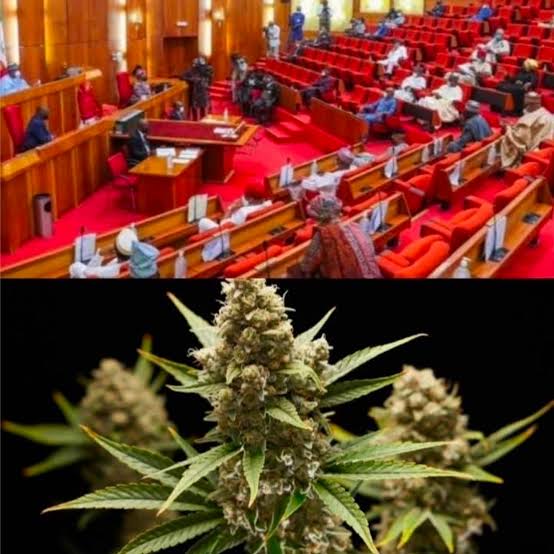
Nigeria’s Marijuana (Cannabis) Law Has Failed. Is It Time to Think Differently?
Every Nigerian city keeps two maps. One is printed on paper, marked by familiar roads, markets and neighbourhoods.
The other exists only in memory. It leads to corners where conversations become whispers, where transactions are hurried, and where everyone seems to know what exists but few admit seeing it.

For decades, the law has searched those corners in pursuit of cannabis. Yet the smoke has remained stubborn, drifting from one generation to the next as though prohibition merely taught it how to change direction.
Perhaps that is where this conversation should begin, not with anger, ideology or applause, but with an uncomfortable question. After decades of prohibition, has Nigeria moved closer to solving the problem, or has the problem simply learned to live in the shadows?
That question is neither an endorsement of cannabis nor an invitation to dismiss its dangers. It is an invitation to examine whether a policy has produced the results it promised.
For years, the national conversation has swung like a pendulum. Some speak of cannabis as though it were no more dangerous than ordinary tobacco.
Others treat the subject as though no further discussion is necessary because the law has already delivered its verdict. Between those extremes lies the place where good policy is usually found.
Former American President John F. Kennedy once remarked, “The great enemy of the truth is very often not the lie, but the myth.” Few public issues have gathered as many myths as cannabis. Some myths exaggerate its benefits.
Others exaggerate what prohibition alone can accomplish. Neither myth relieves a nation of the responsibility to examine evidence. (jfklibrary.org)
British philosopher John Stuart Mill offered another reminder that feels remarkably modern: “He who knows only his own side of the case knows little of that.” If Nigeria is to have an honest conversation, it cannot afford to listen only to those who already agree with one another. (The Daily Idea)
Beyond our borders, countries have reached different conclusions after asking many of the same questions.
In Toronto, cannabis is purchased through a regulated legal system where licensed retailers and government rules govern access and product standards.
In Casablanca, Morocco is building a regulated medical and industrial cannabis sector after decades of prohibition. In Maseru, Lesotho, licensed cultivation has become part of a regulated cannabis industry.
Meanwhile, in many Nigerian cities, the same plant changes hands in an illicit economy where taxes, quality controls and consumer safeguards are absent. One plant. Four countries. Four different philosophies. (Canada)
Canada did not legalise cannabis because it believed the drug had suddenly become harmless. Its Cannabis Act created a framework designed to regulate and restrict access, protect public health and safety, keep cannabis away from young people and reduce the role of organised crime in the market.
The framework includes age restrictions, licensed production and sales, product controls, warning labels and public education. Canada has since reviewed the operation of the law and identified areas requiring continued improvement. (Canada)
Germany has taken a more cautious route. Its 2024 cannabis law allows limited adult possession and private cultivation, as well as non-commercial cultivation associations, within defined restrictions.
Uruguay, which became the first country to establish a nationwide legal framework for adult-use cannabis, continues to operate a state-regulated system.
South Africa has also enacted legislation regulating adult private use and possession while maintaining restrictions around dealing and the protection of children. (BMG)
What these countries share is not a single answer. It is a willingness to revisit old assumptions without pretending that every reform is a miracle.
Back home, the contradiction remains difficult to ignore. Cannabis is illegal in Nigeria. Yet reports of its use continue to emerge from campuses, neighbourhoods, motor parks and even among teenagers.
Arrests are announced. Seizures make headlines. Awareness campaigns are organised. Still, the market survives with remarkable resilience.
During a conversation with Oma for Orbits News in Port Harcourt, Dokubo Chioma, a civil servant, reflected on what he witnesses within his community.
“Even with prohibition, many teenage boys and girls are already getting involved in drugs. The answer cannot stop at arrests. Parents must become more intentional, schools need stronger counselling units, and communities should organise regular awareness programmes. Whatever policy we keep, our children need guidance before they need rescue.”
His words reach beyond legislation. No Act of Parliament has ever replaced the influence of a responsible parent, an attentive teacher or a community that refuses to surrender its young people to silence.
Nigeria’s own relationship with the plant is more complicated than its laws suggest. In some communities, cannabis has existed not only as a substance smoked for recreation but also as part of traditional remedies passed from one generation to another. Some people use preparations made from the plant to manage pain and other ailments, often outside the formal healthcare system.
Whether those practices are medically effective is a question for scientific research, not assumption. But dismissing them without investigation may mean overlooking knowledge that deserves to be studied, tested and either validated or rejected by evidence.
Around the world, research into cannabis-derived medicines has produced approved treatments for specific conditions, while scientists continue to investigate the plant’s potential and limitations.
That does not mean every cannabis preparation sold in a Nigerian village is medicine, nor does it make recreational use medically beneficial.
It means the conversation must be precise enough to distinguish between a plant, a traditional remedy, a pharmaceutical product and an intoxicating substance.
In the United States, for example, the Food and Drug Administration has approved specific cannabis-derived or cannabis-related prescription medicines for particular medical uses; it has not approved cannabis itself as a general treatment for diseases. (U.S. Food and Drug Administration)
It is within that wider conversation that Mr. Adebanju Solomon, speaking to Oma for Orbits News, raised the economic and medical questions surrounding the plant.
“Countries are studying different ways of managing cannabis, and some are generating revenue while supporting medical research. Nigeria should continue to examine those experiences carefully. Economic opportunities, healthcare and public safety all deserve careful consideration before any long-term decisions are made.”
His argument opens another door in a debate that Nigeria has largely kept locked: the question of whether a plant that already exists within an illegal economy could ever be brought under a system where science, public health and government oversight have a place at the table.
In jurisdictions where cannabis is legally regulated, governments have sought to use taxation and licensing as part of a broader framework that includes health protection, education and enforcement. Yet regulation has not erased the risks.
Authorities continue to warn about youth exposure, problematic use and driving while impaired. Legal status does not transform a potentially harmful substance into a harmless one. It changes the framework through which a government attempts to manage access, risk and accountability. (Canada)
Nigeria cannot borrow another nation’s policy the way one borrows a book. Our institutions, healthcare capacity, law enforcement challenges and social realities are different.
A policy that works in Toronto cannot simply be unpacked in Lagos, Kano or Port Harcourt without careful adaptation. Yet refusing to study international experience simply because it is foreign is another way of refusing to learn.
A nation does not grow wiser by preserving every old answer. Sometimes wisdom begins with the courage to ask whether yesterday’s solution is still solving today’s problem.
The cannabis debate is therefore larger than cannabis itself. It is a conversation about law, public health, youth, economics, science and the willingness of a country to measure success by outcomes rather than intentions.
Whatever course Nigeria ultimately chooses, one principle deserves broad agreement. Decisions that affect millions of lives deserve careful evidence, honest debate and institutions strong enough to protect the public, especially young people
History has an interesting habit. It rarely asks whether a nation had laws. It asks whether those laws changed the lives they were written to protect.
Editor’s Note:
This editorial is published as a contribution to public discourse. Its purpose is to examine policy choices through research and comparative experience, not to encourage the unlawful use of cannabis or any other controlled substance.


















https://shorturl.fm/5YyTR