


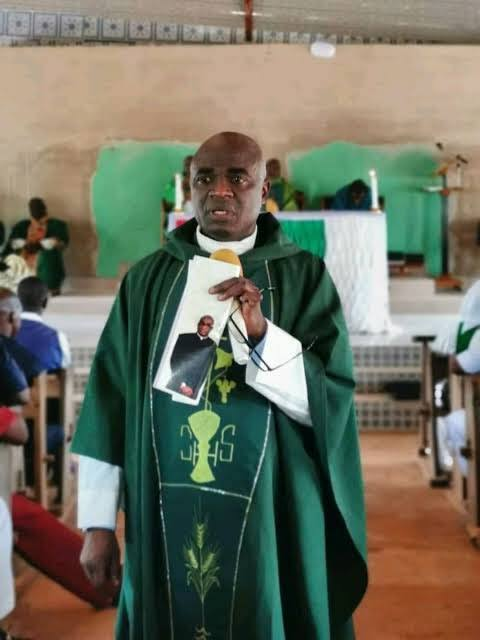
Can a Priest Become Governor? The Controversy Behind Governor Alia’s Catholic Church Suspension
What happens when a Catholic priest believes he can serve God better from the governor’s office than from the altar? Should his bishop stop him?
That question has returned to public debate following Cardinal John Onaiyekan’s recent explanation of why Benue State Governor Hyacinth Alia was suspended from priestly ministry.
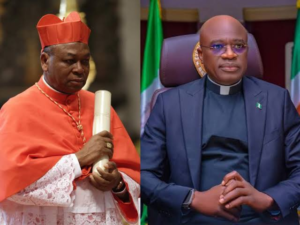
According to Onaiyekan, Alia entered partisan politics despite his bishop’s refusal to grant permission, raising difficult questions about religious authority, political ambition and public service.
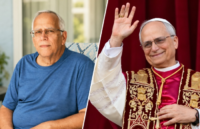
Alia was ordained a Catholic priest in 1990 and became widely known for his pastoral and healing ministry before pursuing the governorship of Benue State.
In May 2022, Bishop William Avenya of the Catholic Diocese of Gboko suspended Alia from ministry after he pursued the All Progressives Congress governorship ticket.
The suspension came a year before Alia became governor in 2023, so the conflict began before he assumed the formal responsibilities of elected political leadership.
Onaiyekan recalled the bishop’s warning: “Okay, if you go, I suspend you.” He said Alia nevertheless proceeded directly despite being denied permission under Church rules.
That account frames the dispute as more than a clash of personalities. It concerns what happens when a priest’s political ambition collides with religious obligations.
The Catholic Church does not prohibit ordinary members from entering politics. Its rules, however, place particular restrictions on ordained ministers because of their pastoral responsibilities.
Canon 285 prohibits clerics from assuming public offices involving civil power, while Canon 287 restricts their participation in political parties under specified circumstances and conditions.
Canon 287 allows an exception when competent Church authority judges participation necessary to protect Church rights or promote the common good. Permission is not automatic.
These rules help explain the bishop’s position, but they do not prevent readers from asking whether restrictions are reasonable or how they should be applied.
Supporters may argue that political leadership offers another route to serve people, with governors able to influence healthcare, education, security, jobs and livelihoods across society.
From that perspective, public office could become another branch of the same tree of compassion, extending service beyond the pulpit to communities across Benue State.
The Church’s concern is different. A priest who openly supports a party may alienate parishioners backing opposing candidates, turning the altar into a partisan battleground.
Imagine worshippers divided by party loyalties. If their priest campaigns for one candidate, those supporting another may wonder whether their spiritual home welcomes them equally.
This is why the Church expects priests to remain apart from partisan competition: their pastoral role requires them to serve people across political and social divisions.
Mark 12:17 records Jesus saying, “Render to Caesar the things that are Caesar’s, and to God the things that are God’s,” about civic obligations today.
The passage does not decide whether a priest should become governor, but it invites reflection on how religious commitments and civil responsibilities can coexist peacefully.
Pope Francis encouraged ordinary Catholics to participate in politics in 2015, saying, “But can a Catholic engage in politics? She must!” during a Vatican address.
He described politics as a way to promote the common good, but those remarks did not give priests unrestricted permission to contest elections or join parties.
The distinction matters. Alia’s case is not simply about whether Christians should participate in public life; it concerns obligations for ordained priests and ministry specifically.
Suspension differs from formal removal from the priesthood. Canon 1333 describes restrictions on ecclesiastical functions, while Canon 290 addresses the formal loss of clerical state.
Therefore, claiming Alia is no longer a Catholic priest requires care. The reported suspension does not, by itself, establish that he has been formally laicised.
The Tablet reported on 13 October 2026 that Alia remains suspended from public ministry but has not been laicised, citing Onaiyekan’s recent comments.
That distinction matters because a priest may be barred from exercising ministry without the Church formally removing him from the clerical state or priesthood itself.
Still, Church rules do not end the debate about fairness. Disciplinary decisions should follow procedures and be explained clearly, consistently and with appropriate care always.
The bishop’s position is that Alia disregarded a legitimate directive. Critics may ask whether the penalty was proportionate and whether meaningful review was properly available.
Alia’s election is a separate matter. His authority as governor comes through Nigeria’s constitutional system, while his religious standing is governed by Catholic canon law.
Winning office does not automatically cancel religious obligations, just as Church suspension does not independently determine whether someone can legally remain governor under Nigerian law.
The controversy also recalls the late Reverend Father Moses Orshio Adasu, another former Benue governor whose entry into politics raised similar questions about priesthood and public office.
Their stories show that tension between altar and government is not new. Political power offers influence, but priesthood carries obligations that cannot be set aside.
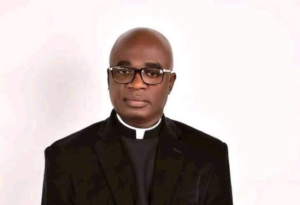
Alia’s case leaves a question hanging: when a priest believes he can help his people through government, should his bishop ultimately have the final word?











Leave a comment