


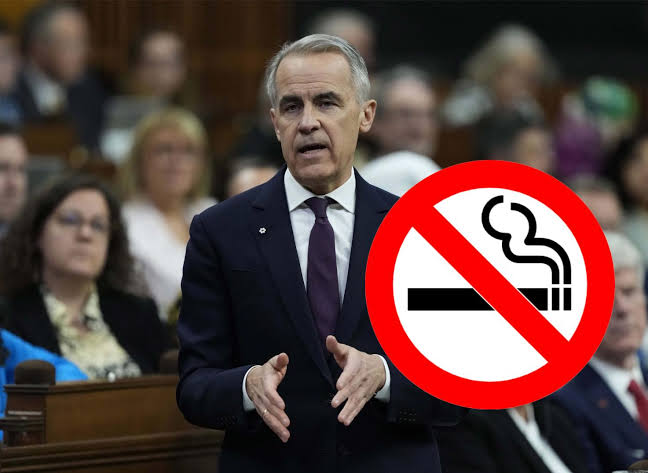
Could Canada Raise a Generation That Never Smokes?
For decades, governments have tried to discourage smoking through health warnings, advertising restrictions and higher taxes. Canada now faces a bigger question: should future generations ever be allowed to start?

The idea challenges conventional tobacco control. Rather than simply restricting sales to minors, supporters want legislation preventing certain generations from legally purchasing cigarettes, even after reaching adulthood.
Britain has already adopted this approach, introducing legislation designed to prevent young people from becoming lifelong smokers. The policy is also prompting discussions about whether Canada should follow the same path.
Under Britain’s Tobacco and Vapes Act 2026, anyone born on or after January 1, 2009, cannot legally purchase tobacco. The law establishes a generational restriction rather than a temporary age limit. (GOV.UK)
The approach would not immediately remove cigarettes from existing adult smokers. Instead, the restriction would apply to successive generations, gradually preventing younger people from legally entering the tobacco market.
Canada’s interest in this proposal goes beyond personal choice. Tobacco-related illnesses create substantial healthcare demands, while smoking-related deaths continue to affect families, workplaces and communities across the country.
A peer-reviewed study by University of Ottawa researcher Doug Coyle, published in January 2025, examined the potential long-term effects of introducing a smoke-free generation policy in Canada.
The research model projected that, over 50 years, the policy could generate approximately 476,814 additional quality-adjusted life years and save about $2.3 billion in healthcare costs.
Quality-adjusted life years measure both longevity and health quality, helping researchers estimate the broader benefits of interventions. The figures represent modelled outcomes, not guaranteed results under actual implementation.
Coyle’s study also projected approximately $7.4 billion in reduced tobacco tax revenue and $3.1 billion less in tobacco industry economic output over the same period.
The findings therefore present a complicated financial picture. Although healthcare savings alone would not offset every economic loss, the researchers concluded that the value of improved health could outweigh those costs.
However, not everyone believes prohibition would deliver its intended benefits. Critics warn that restricting legal purchases could encourage illegal sales, creating additional challenges for regulators, retailers and law enforcement agencies.
Canada’s tobacco market already faces concerns about contraband products. Opponents argue that authorities should strengthen enforcement against illegal suppliers rather than introduce restrictions that could potentially expand their customer base.
There is also a question of fairness. Two adults of similar ages could face different purchasing rights simply because their birth dates fall on opposite sides of a legally established cutoff.
Supporters counter that preventing nicotine addiction before it begins could protect younger generations from avoidable illness. The disagreement ultimately concerns how governments should balance public health with individual freedom.
Cigarettes are not the only concern facing health campaigners. Vaping has become another important part of discussions about nicotine dependence, particularly as young people gain access to increasingly varied products.
Canada’s Lung Health Foundation has advocated stronger measures to protect younger people from nicotine. However, vaping presents additional regulatory questions because some adults use these products when attempting to quit smoking.
Britain’s generational restriction targets tobacco purchases, while its legislation also strengthens controls on vaping products. Canadian policymakers would need to consider whether both categories require identical or different approaches.
Any Canadian proposal would therefore need to address youth protection, smoking cessation support, product regulation and the possibility of consumers turning to illegal suppliers.
Canada already has a tobacco control strategy targeting smoking prevalence below five per cent by 2035. A generational ban could enter future discussions, although the government has not announced plans to introduce one.
The challenge is determining whether lasting behavioural changes can be achieved without creating enforcement difficulties or unintended consequences for existing smokers and businesses.

For governments everywhere, the debate raises an important question: should tobacco control concentrate on helping people quit, or should preventing future generations from starting become an equally important priority?




















Leave a comment