


You Can Meet the Dead Again in This Enugu Community
What if death does not close every door?
What if, somewhere in southeastern Nigeria, there is a community where people still believe the dead can be reached, questioned and, under certain traditional rites, encountered again?
It sounds like the beginning of an old folktale. Yet the story belongs to Amalla-Egazi, a community in Udenu Local Government Area of Enugu State, where an enduring belief has placed the village in an unusual corner of Nigeria’s cultural map.
Amalla has been described in reports as the “Land of the Dead”, a name connected to the community’s belief that death does not completely sever the relationship between the departed and those they leave behind.
The claim is extraordinary. The questions it raises are even more fascinating.
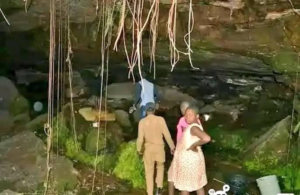
According to accounts from residents, the community recognises sacred places associated with the dead, including Ogo and Eze Ugwu, meaning “King of Hills”. Those who seek contact with deceased relatives are said to undergo traditional rites and observe certain rules before such encounters can take place.
There is no scientific evidence establishing that a living person can travel to a sacred place and communicate with someone who has died.
What can be established is that the belief exists, that it has been preserved within the community and that people continue to tell stories about encounters with the dead. That distinction matters.
The Amalla story is not simply about whether ghosts exist or whether a person can cross an invisible boundary between two worlds.
It opens a much older conversation about death, memory, faith and the human difficulty of letting go.
Long before laboratories and medical textbooks, societies created their own explanations for the silence that follows a person’s final breath. The Egyptians had elaborate ideas about the afterlife.
Christianity speaks of resurrection and eternal life. Many African societies developed their own understanding of ancestors and their continuing place within the family.
Among the Igbo, the dead have traditionally not been regarded simply as people who have vanished.
The concept of the “living-dead” describes ancestors who, although physically gone, are believed to remain connected to their families and communities.
That belief gives Amalla a cultural context that is far older than the mystery surrounding its name.
It also helps explain why stories about the place continue to travel from one person to another. They touch a wound almost every family understands: losing someone while questions remain unanswered.
Mr Anayo Ude, an engineer and an indigene of Enugu State, has never personally visited the place. He said however, that he knows someone who claimed to have gone there and returned with an explanation concerning the death of his relative.
“Someone I know told me that he visited and found out the cause of his cousin’s death,” Ude said.
That is his testimony, not proof of the claim. His admission that he has never visited Amalla himself makes that distinction even more important.
Still, why would anyone want to visit the dead? The answer may lie in the questions grief leaves behind.
A mother who loses a child may spend years wondering what happened in the final moments. A husband may replay the last conversation he had with his wife. A brother may remain troubled by circumstances surrounding a death that never made sense.
Death takes a person away, but it does not always take away the questions.
This is where the Amalla story becomes more than an unusual account from an Enugu community. It becomes a window into the human heart.
The Bible itself recognises the mystery surrounding death and what lies beyond it. Ecclesiastes 9:5 says, “For the living know that they shall die: but the dead know not any thing.”
Christianity also offers a promise that gives death a different meaning. Jesus says in John 11:25, “I am the resurrection, and the life: he that believeth in me, though he were dead, yet shall he live.”
Neither passage proves the Amalla tradition. They simply remind us that questions about death have never belonged to science alone. They have also occupied the territory of faith.
That is why traditional beliefs deserve to be examined with both curiosity and caution.
A belief can be culturally important without being scientifically established. An old practice can deserve documentation without requiring everyone to accept its supernatural explanation.
Africa has lost many traditions without properly recording them. Some disappeared when their custodians died. Others survived only in fragments, carried through family stories and the memories of elders.
We should not assume that every old belief is true. Neither should we assume that every old belief is worthless.
There is knowledge in culture, but there is also myth in culture. The challenge is learning to distinguish one from the other without treating the people who hold those beliefs with contempt.
Christianity has added another layer to that conversation in Igboland. Traditional ideas about ancestors came into contact with Christian teachings about heaven, resurrection, judgement and eternal life.
The meeting was not always a clean replacement of one worldview with another. In many families, old cultural memories continued to sit beside Christian convictions.
Amalla therefore represents something larger than a mysterious village. It sits at the meeting point of an older understanding of death and a modern society shaped by Christianity, education, science and urban life.
Maybe that is why its story refuses to disappear.
There is something haunting about a place where the dead are imagined not as distant shadows but as neighbours across an unseen boundary.
The hill becomes more than a hill. It becomes a symbol of the human desire to knock once more on a door that death has apparently locked.
We all know people who are gone yet somehow remain present.
They live in the photograph tucked inside a drawer. They return in the smell of a particular meal. They appear in the expression of a child who laughs exactly like a grandfather nobody remembers seeing alive.
Psychologists describe part of this experience as “continuing bonds”. People who lose loved ones may maintain an emotional connection through memories, possessions, conversations, rituals and family traditions.
Science does not describe that as communication with the dead. It describes it as one way human beings continue to live with loss.
But the feeling itself is real.
When someone we love dies, memory becomes a strange kind of house. The person is no longer physically there, yet some part of us keeps opening the door.
That may explain why the story of Amalla has such staying power.
Whether the dead can actually be contacted there remains unproven. The available accounts document a traditional belief and personal testimonies; they do not establish the supernatural claim as fact.
But the deeper question is not confined to Amalla.
What do we do with the people death has taken from us?
Do we bury them and move forward because life demands it? Do we preserve their names, tell their stories and allow their values to continue shaping those who remain?
Or do we, in the quiet corners of our lives, continue talking to them in ways we would never explain to anyone else?
The grave may receive the body, but memory keeps opening its windows.
Maybe that is the mystery Amalla leaves behind. It is not only asking whether the living can find their dead. It is asking whether the dead ever completely leave the lives they helped create.
For some, the answer will come from faith. For others, from culture, memory or simple disbelief. Amalla leaves the question standing at the crossroads.
And if you were given one opportunity to ask someone you lost a single question, what would you ask?

















Leave a comment