

The Way We Live: A School That Ended Before The Bell Understood It
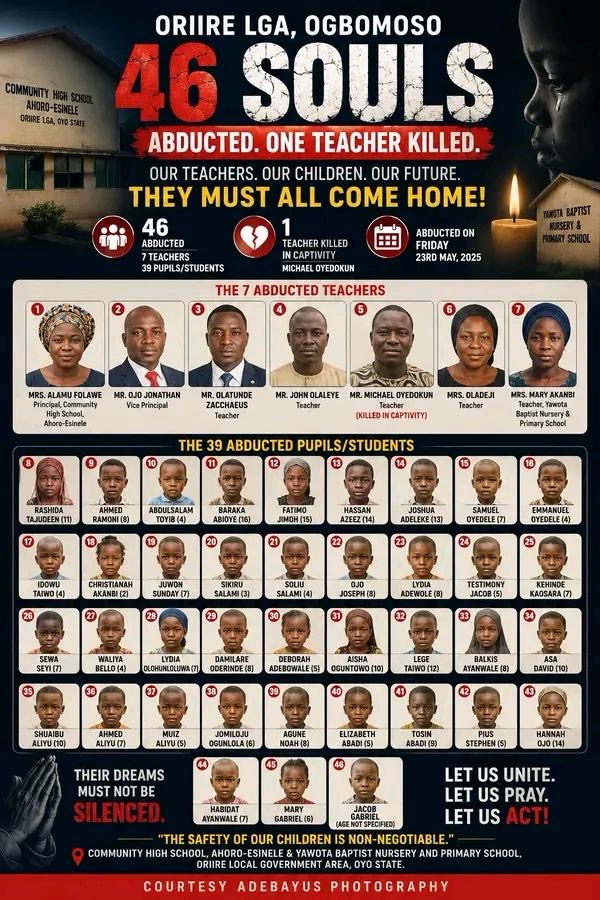
The bell rang in Oyo State just like any other morning. Children moved through the gate in uneven rhythm, some adjusting uniforms, some laughing briefly before the day settled on them.
A teacher stood by the entrance.
He counted heads the way he always did. Not because danger was expected, but because habit had become a quiet form of safety.
Inside the classrooms, chalk met board. Names were called. Attendance moved like routine muscle memory.
Then something shifted. At first, nobody understood what had changed. A shout from outside. Then another. Movement that did not belong to the school timetable.
By the time teachers tried to pull the children back into order, the structure had already begun to break.
People started running. Not together, not in plan, just running. And in that movement, some children stopped being visible. Some teachers too.
When the noise finally reduced, the school was still standing. But it felt emptied faster than it could process what had happened inside it.
No announcement explained it properly. No sentence finished the moment cleanly. Just absence, sudden, incomplete.
Parents arrived later in waves. Some were already crying before they reached the gate. Some kept calling names as if repetition could bend reality.
“Oluwaseun!”
“Bamidele!”
“Yetunde!”
Again and again. The names returned nothing.
Officials spoke in controlled sentences. Search operations. Coordination efforts. Difficult terrain.
But outside those sentences, people were not processing information. They were waiting for reversal.
A woman sat on the ground near the school wall and said quietly,
“Dem go school… but school no return them.”
Nobody corrected her. Not because it was poetic.
But because it was exact.
As Nelson Mandela once said, “There can be no keener revelation of a society’s soul than the way it treats its children.”
But here, the revelation is not in speeches. It is in how quickly a normal morning can lose its ending.
This is not only Oyo’s story. In different parts of the world, schools have learned interruption as routine. In some places, children understand emergency drills before arithmetic. In others, absence has become part of attendance.
Different systems. Same fracture. As Chinua Achebe once warned, “When the house is on fire, the flames are not the only danger.” Because after the flames, what remains is often confusion trying to behave like normal life.
The school still exists. Classes may resume. Bells may ring again. But something has changed in the way people enter gates now. They no longer assume return is automatic.
Maybe insecurity is not only what happens in a moment. Maybe it is what continues living inside people after the moment has passed.
COMMENT HOOK:
What changes first after an incident like this in a community, the way children learn, the way parents trust, or the way safety is understood?