


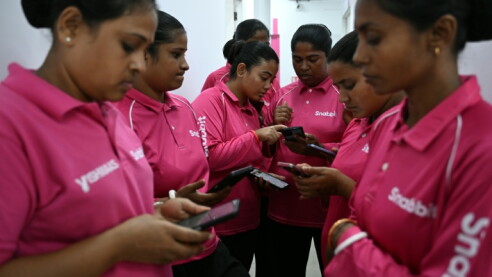
India’s Domestic Workers Turn to Apps for Jobs and Better Pay
NEW DELHI — India’s domestic work sector is undergoing a digital transformation as startups use mobile applications to connect households with workers who clean homes, wash dishes, cook and perform other household tasks.
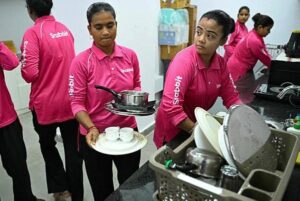
At a training centre in Bengaluru, a group of women races against the clock as they practise folding bedsheets, chopping vegetables and carrying out other tasks required for their new jobs.
Their work is being organised through mobile apps rather than traditional personal referrals.
For decades, millions of domestic workers in India have found jobs through informal networks, often moving between several households each day.
A growing number of technology companies are now seeking to bring structure to the sector, which employs an estimated 30 million people.
Platforms including Snabbit, Pronto and Urban Company allow customers to book domestic services online. Workers receive assignments through the apps, travel to customers’ homes and record their working hours digitally.
Their performance is also monitored through customer ratings, while incentives and penalties may be influenced by algorithm-based systems.
For 34-year-old Heena Bibi, the arrangement has significantly improved her earnings.
“Doing the same work with a company is good,” she said, adding that she earns about 45,000 rupees (US$472) a month, roughly three times what she previously made through traditional domestic work arrangements.
“I get three or four jobs on a normal day. If there is a festival, there is more work,” said Bibi, a mother of four.
The flexibility offered by app-based work is another attraction for many workers, particularly mothers.
Aayush Agarwal, founder and chief executive of Snabbit, said women could take their children to school, work for a few hours and return home before their children came back.
But the model has also raised concerns about safety and workers’ rights.
Renu Devi, a 38-year-old domestic worker from Uttar Pradesh, said she remained uncomfortable with the idea of travelling to homes where she did not know the occupants.
“I am scared that I might have to go to a house where I don’t know if I will be safe,” she said. “At the moment, I know the people who I work for and I can trust them.”
Labour advocates have also questioned whether app-based employment offers genuine improvement in working conditions.
Sanjay Gaba, president of the All India Gig and Platform Workers Union, said workers on such platforms lacked the security and benefits associated with permanent employment.
“They don’t have any job security. They don’t have benefits like pension because they are not permanent employees,” he said.
Companies operating the platforms argue that they are expanding opportunities for workers who have traditionally depended on informal arrangements.
Snabbit operates in 10 cities, including Delhi and Mumbai, with about 20,000 registered workers carrying out an average of 60,000 jobs each day.
Before joining the platform, workers undergo background checks, including police verification. They also receive training on customer service and professional conduct.
At the company’s training centres, workers are taught how to interact with customers and are assessed through ratings after completing jobs.
Bhoomika Saigal, Snabbit’s director of training and quality, said the company follows up with workers who receive low ratings to understand the reasons behind the complaints and provide further support where necessary.
For customers, the convenience of booking help on demand is a major attraction.
Atiya Khusro, a 63-year-old homemaker, said online bookings allowed her to arrange household assistance without having to organise her schedule around the availability of a regular domestic worker.
“With regular helps, there is a fixed schedule, and I have to adjust my routine around their availability,” she said. “With instant helps there is no such issue.”
The model is part of India’s rapidly expanding gig economy, with technology platforms increasingly connecting customers with workers offering a wide range of services.
Pronto, for example, offers hourly household services including window cleaning and post-party clean-ups, while Urban Company provides domestic services alongside repairs, beauty treatments and other offerings.
For Agarwal, the future of domestic work lies in making household services available whenever customers need them.

But as more domestic workers move online, questions about job security, safety, wages and employment rights are likely to remain at the centre of the debate over India’s new digital labour market.

























https://shorturl.fm/1xee8
https://shorturl.fm/JU7D4
https://shorturl.fm/Mhpmd