

Trump Unveils New Tariffs on More Than 80 Countries, Sparking Backlash
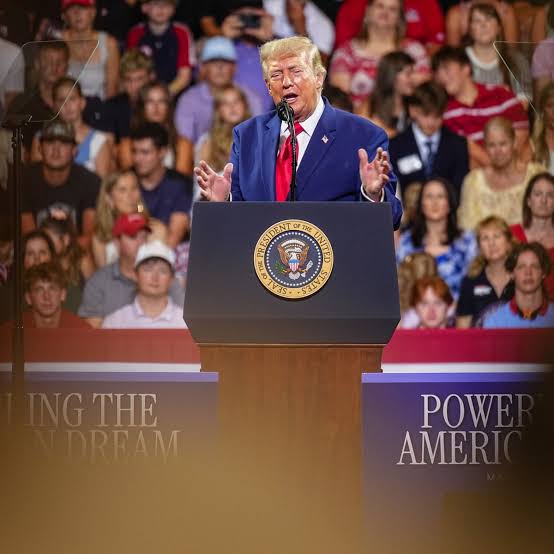
US President Donald Trump has introduced a fresh round of tariffs on goods from more than 80 countries, triggering immediate criticism from several allies and major trading partners.
The new duties, ranging between 10% and 12.5%, replace a temporary 10% global tariff that expired early on Friday. The affected countries include the United Kingdom, Canada, Mexico, Australia, India, China and the 27-member European Union.
The tariffs were announced late Thursday by US Trade Representative Jamieson Greer under Section 301 of the Trade Act of 1974, a provision that allows the United States to respond to what it considers unfair trade practices.
The Trump administration says the new measures are linked to forced labour concerns and argues that countries trading with the US should do more to prevent goods produced through forced labour from entering their markets.
“The United States has had a forced labor import ban for nearly a century, and rigorously enforces it; it’s well past time for our trading partners to do the same,” Greer said.
The announcement was quickly met with opposition.
Australia and Brazil described the tariffs as unjustified and said they would seek their removal, while Norway’s foreign minister said there was no clear basis for the measures.
The European Union also expressed concern. EU foreign policy chief Kaja Kallas said the bloc would seek clarification from Washington, describing the new tariffs as a shock and stressing that the EU had fulfilled its commitments under a transatlantic trade agreement reached last year.
Canada, one of the United States’ biggest trading partners, also rejected the move, insisting that it should not be targeted over forced labour concerns.
“If the intent is truly to address forced labour, the focus should be a coordinated approach through a multilateral mechanism,” said Matthew Holmes, executive vice-president of the Canadian Chamber of Commerce.
The latest tariff decision comes months after the US Supreme Court struck down many of Trump’s earlier tariffs, ruling that the president had exceeded his authority by imposing sweeping duties under an emergency powers law.
The court held that the power to impose taxes and tariffs rests with Congress. Trump subsequently turned to another trade law to introduce a temporary 10% tariff regime, which expired just after midnight on Friday, US Eastern Time.
The new tariffs are now being imposed under Section 301, a law that has been used only sparingly and has already raised fresh questions about the limits of presidential power.
Alan Wolff, a senior fellow at the Peterson Institute for International Economics and former deputy director-general of the World Trade Organization, argued that the latest move could face another legal challenge.
He said Congress had not given the president authority broad enough to determine and implement US tariff policy on such a scale, warning that the measures could amount to another case of presidential overreach.
Trump has consistently defended tariffs as a tool for protecting American jobs, supporting domestic manufacturing and reducing trade imbalances. He has also repeatedly described tariffs as one of his favourite instruments of economic policy.
However, the policy has faced growing criticism at home as well as abroad.
A Harris Poll conducted earlier this year found that 70 per cent of Americans believed Trump’s tariffs had made goods more expensive, while 72 per cent of voters said the tariffs had negatively affected consumers.
The criticism extended to Republican voters, with 64 per cent saying the tariffs had pushed prices higher and 60 per cent describing their impact on consumers as negative.
Despite the criticism, the Trump administration continues to insist that its trade policies have benefited American households and have not been responsible for rising prices.
The latest tariffs could now become another major source of tension between Washington and its trading partners, while also fuelling a fresh legal and political battle over the extent of presidential power over US trade policy.