

By: Chioma Madonna Ndukwu
Who Should Raise a Child—Parents or Social Media?
“Children do not become what we tell them. They become what they constantly see.”

The school bell had just rung.
Students poured out through the gate in twos and threes. Some laughed as they compared test scores. Others hurried towards waiting parents. A few already had their eyes fixed on the glowing screens in their hands.
Standing by the gate with a microphone for Orbits News, I spotted a quiet-looking boy adjusting the straps of his school bag.
“My name is Possible Nwoko,” he said with a shy smile. He is 13 years old and a secondary school student from Rivers State.
When asked what he uses a phone for, his answer came without hesitation.
“For research,” he replied. “If my teacher gives us homework, I use the internet to look for information. I also watch educational videos because they help me understand some topics better.”
He paused, smiled again and added honestly,
“On weekends, after I finish my homework, I sometimes play games.”
There was nothing rehearsed about his response. He did not sound like a child addicted to social media. Neither did he sound like one who feared technology.
He sounded like what many children are today, young people trying to balance learning and leisure in a world where almost everything now lives behind a screen.
Yet while Possible sees a phone as a learning tool, governments across the world are beginning to see it differently.
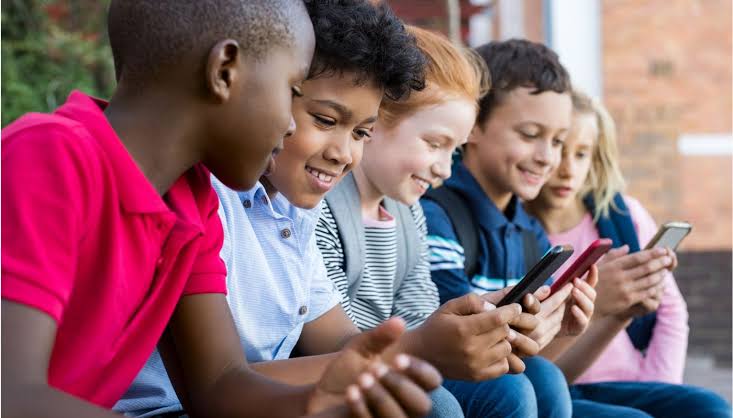
From Australia to France, the debate is growing louder. Several countries have introduced or proposed restrictions preventing children below certain ages from opening social media accounts. Their argument is simple: childhood should not be handed over to algorithms.
Supporters of the restrictions say children today are growing up in an online world that moves faster than their ability to understand it.
They worry about cyberbullying, online predators, pornography, gambling content, dangerous viral challenges and endless hours of scrolling that slowly replace books, conversations and outdoor play.
They believe governments can no longer leave the responsibility to parents alone.
“Technology is a wonderful servant,” an old saying goes, “but a terrible master.”
For many families, that warning no longer sounds like a proverb. It sounds like everyday life.
Mrs. Kamsi Okoye, a secondary school teacher, believes children below the age of 15 should not have unrestricted access to smartphones.
Speaking with Oma for Orbits News, she did not hide her concerns.
“Many parents buy phones for their children because they want them to fit in,” she said.
“But they forget that the internet is not a classroom alone. Children are exposed to pornography, violence, fraud, cyberbullying and all sorts of evil at a very tender age. Many of them are simply too young to separate what is right from what is wrong.”
As someone who interacts with teenagers every day, she believes unrestricted internet access is quietly changing attitudes inside classrooms.
“You can almost tell when a child has been influenced by unhealthy content online. Sometimes it reflects in their language, behaviour and even the way they relate with others.”
She paused before adding,
“I am not against technology. I am against giving children responsibilities they are not yet mature enough to handle.”
Her words echo the fears of many parents who now feel they are competing with phones for their children’s attention.

But not everyone agrees that banning social media is the answer.
To understand how people outside Nigeria view the issue, Orbits News spoke with residents in different countries where the debate has become part of everyday conversation.
In France, where lawmakers have approved restrictions for children under 15, one father described the decision as long overdue.
“A child needs time to discover the real world before getting lost in the virtual one,” he said. “There will always be enough years ahead for social media.”
A mother living in the United Kingdom shared a similar opinion.
“The pressure on parents has become too much,” she explained. “Children see what their friends are doing online and immediately want the same freedom. Having clear national rules makes those conversations at home a little easier.”
Not every voice supported the restrictions.
A university student in Canada argued that banning children from social media could produce the opposite effect.
“If teenagers want to get online, many will simply use VPNs or fake accounts,” he said. “Instead of protecting them, we may be pushing them towards places where parents have even less control.”
His concern mirrors the view expressed by Telegram founder Pavel Durov, who believes no government policy can replace responsible parenting. According to him, children need guidance more than prohibition.
Listening to all these voices, one thing becomes impossible to ignore. Both sides have valid concerns.
No caring parent wants a child exposed to explicit content, online predators or digital manipulation. At the same time, the internet has become one of the world’s biggest classrooms.
Millions of children rely on it for research, assignments, language learning, science experiments and educational videos.
Take Possible Nwoko, for instance. To him, the phone is not merely a device for entertainment. It is where homework begins when the school library has no answer.
It is where difficult Mathematics lessons become easier through a video explanation. It is where curiosity finds information within seconds.
Should that opportunity disappear because others misuse the same technology? Perhaps that is the wrong question.
Perhaps the better question is whether society has taught children how to use technology before placing it in their hands.
An African proverb says, “The child who is not shown the path will create one.” Maybe that is exactly what is happening.
Parents are busy. Teachers are overwhelmed. Technology companies are chasing profit. Governments are making laws. Somewhere in the middle stands the child, curious, impressionable and eager to belong.
The debate, then, is bigger than social media. It is about parenting. It is about values.
It is about whether adults are still shaping young minds or whether screens have quietly taken over that role. Phones are not evil. Neither is the internet.
Like a kitchen knife, they can prepare a meal or cause injury. The difference has never been the tool. It has always been the hand that holds it.
As more countries tighten their rules, one truth remains. No law can hug a child after a difficult day. No app can replace a parent’s guidance. No algorithm can teach wisdom the way patient conversations around the dinner table can.
Perhaps the debate is not about keeping children away from social media. Perhaps it is about making sure social media never takes children away from childhood.

Because one day, every child will hold a phone. The real question is whether wisdom will arrive before the password.