


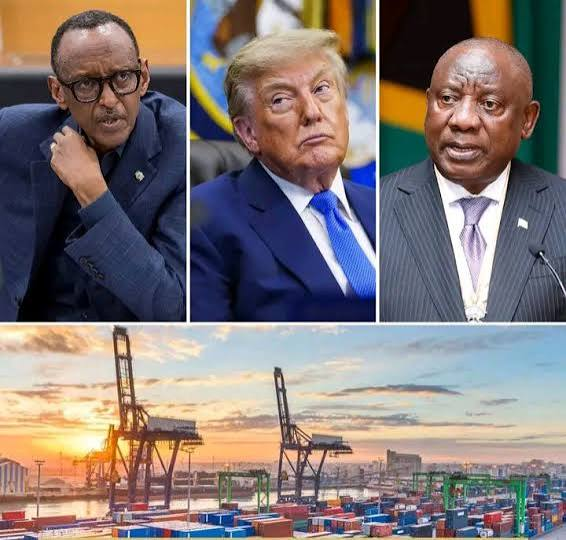
US Strips South Africa and Rwanda of Duty-Free Trade Privileges, Effective 2027
The United States has announced plans to remove South Africa and Rwanda from its preferential trade programme for African countries, threatening billions of dollars in export opportunities.
The decision, which takes effect on January 1, 2027, will end their access to duty-free trade benefits under the African Growth and Opportunity Act (AGOA).

US Trade Representative Jamieson Greer informed Congress on Monday that both countries no longer met the programme’s eligibility requirements.
Washington cited concerns involving human rights, corruption, national security and policies it considers contrary to American foreign policy interests.
In a statement, Greer said President Donald Trump had determined that the governments of South Africa and Rwanda were engaging in practices inconsistent with AGOA’s requirements.
Established in 2000, AGOA has remained a major pillar of American economic relations with sub-Saharan Africa.
The programme allows eligible African countries to export thousands of products into the American market without paying certain import duties.
South Africa, the programme’s biggest beneficiary, stands to face significant consequences from the latest announcement.
The country exported approximately $1.7 billion worth of goods to the United States through AGOA in 2025.
Its major exports include automobile components, citrus fruits and wine, while Rwanda benefits from duty-free access for products including coffee and minerals.
South Africa’s trade ministry said it would support industries affected by Washington’s decision while maintaining efforts to strengthen commercial relations with the United States.
The ministry acknowledged AGOA’s importance but stressed that the programme represented only part of the broader economic relationship between both countries.
Rwanda had not issued an immediate response to the announcement as of Monday night.
RWANDA’S EXPULSION LINKED TO EASTERN CONGO CONFLICT
American officials also raised concerns about human rights, the rule of law and security developments involving Rwanda.
Analysts believe Washington’s decision may be connected to the ongoing conflict in eastern Democratic Republic of Congo, where the United States accuses Rwanda of supporting armed rebels.
Kigali has faced growing international pressure over the conflict, although the allegations remain a major point of diplomatic tension.
Washington has previously sanctioned several Rwandan individuals and institutions, including the country’s military and a gold refinery.
Rwanda has also faced restrictions under AGOA since 2018, when the United States suspended its duty-free treatment for Rwandan apparel.
The earlier restriction followed a dispute over import tariffs that Washington considered harmful to American trade interests.
Meanwhile, Democratic lawmakers in the United States have criticised the decision to remove South Africa from the programme.
Representative Richard Neal, the leading Democrat on the House Ways and Means Committee, described the move as another trade decision driven by political grievances.
He called on the administration to provide a clearer explanation and identify the conditions South Africa must satisfy to regain eligibility.
SOUTH AFRICA CONSIDERS NEW TRADE PARTNERS
Despite the suspension, South Africa will retain access to the American market, although its exporters could face less favourable trading conditions.
Ebenezer Obadare of the Council on Foreign Relations said the development could encourage African countries to explore alternative international trade partnerships.
He warned that changes in American policy could push South Africa and other affected countries towards new commercial relationships, including stronger ties with China.
Obadare also suggested that African governments might already be exploring alternative markets rather than depending heavily on American trade preferences.
The decision comes amid growing diplomatic disagreements between Washington and Pretoria over several international and domestic issues.
The Trump administration has previously accused South Africa of persecuting white citizens, an allegation strongly rejected by the South African government.
Washington has also criticised Pretoria’s foreign policy, particularly its decision to institute genocide proceedings against Israel at the International Court of Justice.
Israel has consistently rejected the genocide allegations brought against it.
The US ambassador to South Africa described the termination of AGOA benefits as a predictable consequence of Pretoria’s refusal to address Washington’s concerns.
However, South Africa’s trade ministry maintained that the United States remained an important economic partner.
It also announced plans to accelerate efforts towards expanding export opportunities in other international markets.
According to the ministry, AGOA-related exports account for approximately 10 per cent of South Africa’s total exports to the United States.
They also represent only about one per cent of the country’s overall exports worldwide.
President Cyril Ramaphosa had previously acknowledged the possibility of losing AGOA benefits and urged South Africa to prepare for the consequences.
His government has consequently pursued alternative trade arrangements, including stronger commercial engagement with China.
The January 2027 suspension now raises fresh questions about the future of American-African trade relations and the economic consequences for countries previously benefiting from preferential access.























Leave a comment