


By: Chioma Madonna Ndukwu
The Way We Live: Love That Could Not Survive Graduation
Emeka knew something had changed the moment Amaka stopped calling him the way she used to.
Though she didn’t say it directly, but silence has a way of arriving before truth does.
Weeks before graduation, she began speaking less about “we” and more about “I.” That was the beginning of everything.
When they first met, she was a struggling university student trying to survive a city that demanded more than she had. Rent was a constant fear. Food was uncertain. The future felt like something happening to other people.

Emeka worked in a small mechanic workshop near her campus. He was not polished, not wealthy, and not the kind of man her world would later start describing as “ideal,” but he was steady in a way she had never experienced before.
The first time she spoke to him properly was when her phone stopped working. She walked into the workshop frustrated, already close to tears because she had missed an important school deadline. He fixed it without asking for anything.
“You didn’t have to help me like that,” she said.
Emeka wiped his hands and looked at her briefly.
“People already do enough ignoring in this world,” he said. “I don’t want to add to it.”
She didn’t respond immediately, but she remembered it. After that, she kept coming back.
When rent became a problem, Emeka helped. When she needed textbooks, he found a way.

When school felt too heavy, he sat with her in silence until she could breathe again.
One evening, she told him, “You make life feel like it’s not fighting me all the time.”
Emeka smiled.
“That’s because I haven’t told you what life really does yet,” he said lightly.
They laughed, but what they didn’t realize was that laughter was becoming the only language holding them together.
Over time, Emeka stopped seeing it as support and started seeing it as a future.
He believed they were building something that would last beyond struggle. And in her own way, Amaka believed it too. Until graduation arrived.
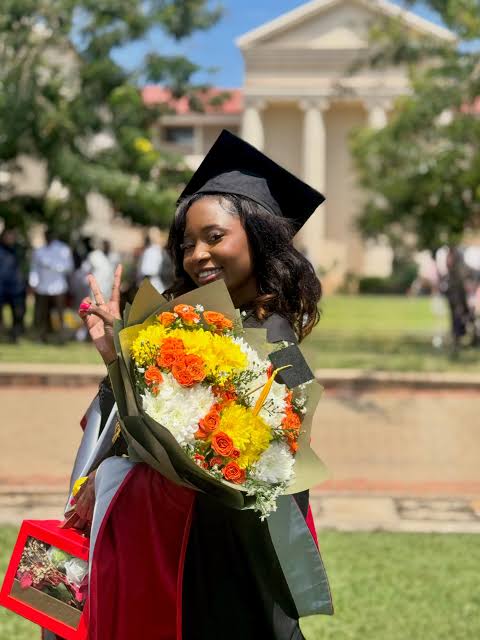
On the day of her ceremony, Emeka stood outside the hall holding flowers he could barely afford, watching her walk across the stage in a gown that made her look like she belonged to another version of life.

He clapped harder than anyone else, because she had become everything she worked for.
After the ceremony, he met her friends for the first time. Their conversations moved differently. Faster and sharper. Words like “career path,” “abroad,” and “postgraduate options” filled the air naturally, like they had always belonged there.
Emeka smiled, but he didn’t fully follow everything they said.
On the drive home, Amaka stayed quiet for a long time before finally speaking.
“I feel like I’m entering a different space now,” she said.
Emeka kept his eyes on the road.
“What kind of space?” he asked.
She hesitated.
“A space where I’m not sure we fit the same way anymore.”
The words didn’t come with anger. That was what made them harder to hold.
Because anger gives something to respond to. Clarity does not. Emeka didn’t speak for a while.
Then he said, quietly, “I was with you when there was no space at all.”
Amaka looked down.
“I know,” she said.
And that was the truth neither of them could escape.
That night, Emeka sat outside the workshop long after closing hours. He remembered something he once heard from the Nigerian author Chimamanda Ngozi Adichie, who said, “Love is not enough when it is not grounded in mutual recognition.”
At the time, he had thought love was simply about endurance. Now he was not so sure.
Amaka, on her side, was not celebrating either. Success had arrived, but it came with questions that didn’t have clean answers.

Was she growing into herself… or growing away from someone who mattered?
That confusion stayed with her after she recalled a line from former South African president Nelson Mandela, who said, “There is no passion to be found playing small in settling for a life less than the one you are capable of living.”
But what happens when the life you are capable of living no longer fits the life you built with someone else?
One evening, she saw Emeka sitting alone near the workshop. He wasn’t doing anything. Just watching traffic pass like it might explain something it never would.
She stopped for a moment, then continued walking, not that she didn’t care, but distance sometimes grows quietly until recognition becomes uncertain.
And Emeka stayed there long after she was gone. Because what hurt most was not losing her. It was realizing he helped build a future that no longer had space for him.

Moral:
Love does not always end in conflict. Sometimes it ends in growth that no longer aligns, leaving behind memories that both people carry differently.
My Personal Thoughts:
Many relationships begin in shared struggle but do not survive shared success. And sometimes the hardest part of love is not holding on, but accepting when two lives no longer move in the same direction.
Comment Hook:
If someone stood by you when you had nothing, do you owe them your future even when your life has changed?















https://shorturl.fm/JTFSD