


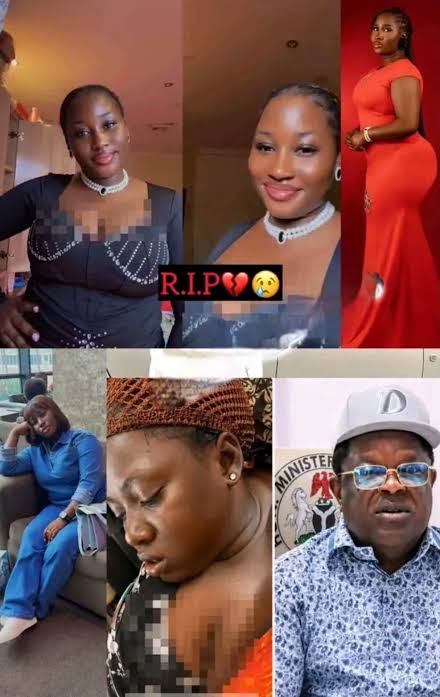
Umahi Under Fresh Pressure as New Twists Deepen Mystery Surrounding Mary Habila’s Death
Fresh controversy has continued to surround the death of 26-year-old Mary Habila, the nurse attached to the Minister of Works, David Umahi, as demands for an independent investigation gather momentum across the country.
Mary reportedly died on June 27 inside a room at a staff chalet located within Umahi’s country home in Uburu, Ohaozara Local Government Area of Ebonyi State.
Although the incident occurred weeks ago, public attention intensified after details of the case emerged, triggering widespread calls for transparency over the circumstances surrounding her death.
The controversy has taken a fresh turn following a legal battle over whether an autopsy should be carried out.
While Umahi has repeatedly maintained that a post-mortem examination is necessary to establish the exact cause of death, Mary’s father has asked the Ebonyi State High Court to stop the police from conducting an autopsy and discontinue further investigation.
The family’s position has generated mixed reactions, with lawyers and rights advocates insisting that deaths surrounded by unanswered questions must be subjected to thorough forensic investigation.
Former Vice President Atiku Abubakar has joined the growing calls for an independent probe, urging President Bola Ahmed Tinubu to direct Umahi to temporarily step aside while investigations continue.
According to Atiku, “This is not a punishment; it is the minimum standard of public accountability in any serious democracy. No official under this cloud should preside over a federal ministry as though it were business as usual.”
He also urged the Inspector-General of Police to transfer the investigation from the Ebonyi State Police Command to the Force Headquarters and involve independent forensic experts.
Atiku further demanded “a full, independent and internationally credible autopsy” whose findings should be made public, while calling on authorities to ensure that Mary’s family is protected from intimidation or undue influence.
Human rights activist and Sahara Reporters publisher, Omoyele Sowore, also called for a coroner’s inquest, insisting that the circumstances surrounding Mary’s death require a comprehensive forensic investigation before any burial takes place.
Meanwhile, Mary’s burial, which had been scheduled to hold in Kaduna State, has been postponed indefinitely.
Although no official explanation was given for the postponement, it comes as the police insist that investigations must continue despite the family’s request for the release of her body.
Adding another layer to the controversy, legal advice issued by the Ebonyi State Ministry of Justice indicated that several crucial questions surrounding Mary’s death remain unresolved.
The advice, signed by the Director of Public Prosecutions, J.U. Chukwu, stated that Mary was found alone inside her room, lying naked on the floor with blood stains around her nose and mouth.
It also noted that there was no evidence she had been ill before her sudden death.
According to the legal advice, “That there was no evidence that the deceased was indisposed, sick or unstable health-wise prior to her sudden death, as she was full of life at the time she returned to Uburu in company of her team.”
The ministry concluded that only a scientific examination could provide answers.

It stated, “The question that would readily come to mind is what exactly caused the deceased’s sudden death? This curiosity under the law can only be resolved through a post-mortem examination, so as to provide a clue to the police as to the direction of their investigation.”
Despite that recommendation, Mary’s father, Tanko Habila, has remained opposed to an autopsy.
In an affidavit before the court, he said, “While I welcome steps being taken to unravel the cause of my daughter’s death, my family and I will not accept any autopsy.”
The affidavit revealed that Mary worked with the David Umahi Federal University of Medical Sciences before she was deployed to the Federal Ministry of Works about three years ago, where she served as Umahi’s personal nurse.
According to the affidavit, she stayed both at the minister’s Abuja guest house and at the staff quarters in Ebonyi whenever official duties required.
The father also insisted that the family wished to bury her body intact and opposed both the autopsy and further investigation.
He added, “I was never induced, coerced or influenced in any way by anybody to make these depositions.”
However, legal practitioner and rights activist Hameed Jimoh argued that the family cannot legally stop an autopsy where the circumstances of a death require criminal investigation.
According to him, “Criminal investigation in cases of alleged murder or suspicious death is the sole responsibility of the police.”
He added, “The government has obligations under international human rights law to respect, protect and fulfil the right to life. Therefore, where the loss of life of a citizen is involved, the matter becomes one for the state.”
Jimoh maintained that an autopsy remains one of the most important forensic tools available to investigators.
“In my humble opinion, the family has no legal capacity to stop either the investigation or an autopsy where it is considered necessary,” he said.
Fresh details have also emerged from Anita Baaki, a close friend and colleague of the deceased, who narrated Mary’s final moments.
According to her affidavit, she travelled with Mary and other members of the minister’s medical team from Abuja to Ebonyi for an official assignment.
She recalled seeing Mary on the evening of June 26 after she returned from having her hair done.
Baaki said, “Mary told me she was tired and wanted to take a shower before sleeping. That was the last time I saw her alive.”
She explained that concern arose the following morning after repeated phone calls to Mary went unanswered.
When staff eventually forced open the room, Mary was found lying unconscious near the entrance and was rushed to the David Umahi Federal University Teaching Hospital, where doctors confirmed she was dead on arrival.

Despite the controversy, the Ebonyi State Police Command has maintained that investigations will continue.
Police spokesperson Joshua Ukandu said detectives visited the scene, obtained statements from witnesses and were making arrangements for a qualified pathologist to conduct the autopsy.
According to the police, “The examination remains necessary given the sensitive nature of the case and the imperative of establishing the true cause of death.”
The command also stated that members of Mary’s family would be invited to witness the procedure to ensure transparency.
Responding again to the controversy on Thursday after the Federal Executive Council meeting in Abuja, Umahi denied any suspicion of foul play and described attempts to link him to the incident as politics.
He said Mary had worked closely with him for about three years and was “like a daughter.”
According to the minister, “The lady in question was like a daughter to me. She stayed with me for three years. She was a staff member of the Federal Medical University. She was a nurse and not a physiotherapist. Her family and my family are like one family.”
Umahi disclosed that Mary had been receiving treatment for an undisclosed medical condition and revealed that he personally paid a hospital bill of about N2.2 million for her in April.
He also claimed Mary informed her boyfriend shortly before her death that she experienced a nosebleed, which later stopped.
According to him, the boyfriend advised her to seek medical attention before ending the call.
“Three minutes later, the boyfriend called back, but she was no longer responding,” Umahi said.
The minister explained that colleagues became worried the next morning after Mary failed to leave her room.
When the door was forced open, she was found dead while the bathroom tap was still running.
Umahi argued that the incident occurred inside a staff guest house and not his personal residence, insisting that investigators should obtain the telephone records between Mary and her boyfriend to better understand her final hours.
He concluded, “I suspect no foul play because the room was locked from the inside and had to be broken open before they discovered the body. The investigation should continue, but an autopsy is necessary.”

As pressure continues to mount, the unresolved circumstances surrounding Mary Habila’s death have kept public attention firmly on the case, with many Nigerians insisting that only a transparent and independent investigation can provide credible answers.













https://shorturl.fm/fp5rp
https://shorturl.fm/Fz6M1