


By: Chioma Madonna Ndukwu
The Way We Live: A country Speaking Through Protest
Aminu stopped walking when he heard the chanting before he saw the crowd.
“APC must go!”
“The president must go!”
The voices were not scattered. They were joined, heavy, like they had been held back for too long.
He followed the sound.
By the time he reached the junction in Abuja, the street had already changed.
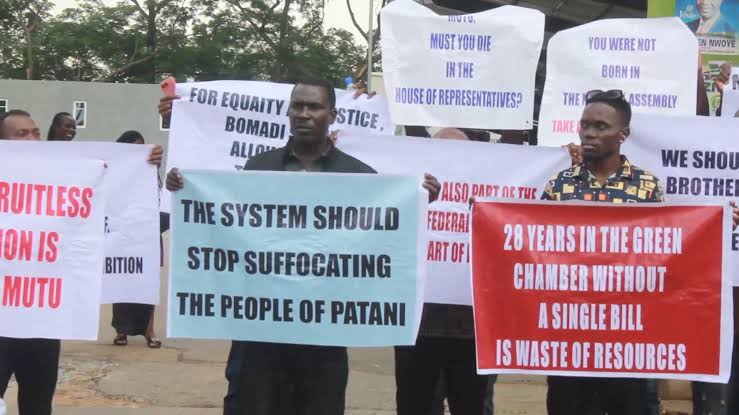
People filled the space. Placards were raised. Phones were recording. Voices rose, broke, and rose again.
“Bandits are taking over our lives!”
“We cannot continue like this!”
That morning, protests had spread across Nigeria, with citizens demanding urgent action over rising insecurity, kidnappings, and repeated attacks in different communities.
In Abuja, social media activist Martins Vincent Otse, known as VeryDarkMan, moved with the crowd as they marched toward government institutions.
But what people carried that day was not only anger, it was lived experience. A woman standing near the roadside spoke while holding her placard tightly.
“Our school children were taken with their teachers,” she said. “One of the teachers was killed. Some of those children are still missing. Even toddlers were among them.”
Her voice dropped for a moment before she continued.
“And people are not safe in those camps. Our women are being raped in kidnappers’ den. Families are not just losing people… they are losing dignity too.”
A young man beside her shook his head. “This is what we are talking about,” he said. “No one is safe anymore.”
The chant came again from the crowd.
“We are tired!”
Then louder.
“The president must go!”
“APC must go!”
The sound moved through the street like something long stored and finally released.
A retired civil servant standing nearby murmured to a younger woman, “Eleanor Roosevelt once said, ‘It is not fair to ask of others what you are unwilling to do yourself.’”
She nodded without looking away from the crowd.“Then leadership must feel what people are feeling,” she replied.
A student nearby repeated something she had once read from Wangari Maathai.
“It’s the small actions citizens take that change everything,” she said softly.
The crowd did not need amplification, it already carried enough emotion on its own. A taxi driver said he avoids certain highways now.
A trader said she no longer sends her children on long trips without constant check-ins. A father said he cannot sleep when his daughter is on the road.
Every story sounded different, but all of them circled the same reality. Life had been adjusted around fear.
In Texas, a Nigerian nurse told her family she now shares her live location during night shifts.
In Mumbai, a father waits awake until his daughter’s ride is confirmed home.
In Nairobi, a shop owner closes earlier than before because safety now comes before profit.
Different places, same quiet changes in how people live. The Abuja protest moved like a long conversation the country had delayed for too long.
Not just about leaders, not just about politics. But about whether ordinary life still felt safe enough to call normal.
By afternoon, the chants had not reduced. If anything, they had become more certain. People were not only asking to be heard. They were insisting they had already waited too long.
As the crowd slowly dispersed, a man sat on the pavement and said quietly, “If all these people are here today, then something has been wrong for a very long time.”
No one argued because no one needed to. The city would return to traffic and routine. But for those who stood there, something had already shifted. Not in policy yet, but in voice.
Moral: When a society begins to speak openly about its pain, it is usually not the beginning of unrest but the end of prolonged silence.
Comment Hook: At what point does a society decide that silence is no longer an option?A Country














https://shorturl.fm/YvCNL