



By: Chioma Madonna Ndukwu
Willful Murder or Postpartum Psychosis? The Mother Who Strangled Her Three Children
There are some stories that leave a person staring at the page long after the last sentence. This is one of them.
A mother in Massachusetts strangled her three young children to death. She then climbed to a second-storey window and jumped, apparently trying to end her own life. The fall left her paralysed from the waist down.

Three children were gone, but their mother survived. And nearly four years later, the question of what happened inside her mind remains unanswered.
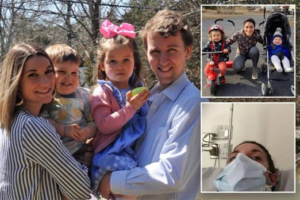
Lindsay Clancy, a mother from Duxbury, Massachusetts, was charged with killing her five-year-old daughter, Cora, three-year-old son, Dawson, and eight-month-old son, Callan, on January 24, 2023.
She admitted killing the children. What she did not accept was the idea that she was criminally responsible for their deaths.
Her defence argued that she was suffering from severe postpartum psychosis, a rare psychiatric emergency that can cause hallucinations, delusions, confusion and a frightening break from reality.
Prosecutors argued that she acted intentionally and knew what she was doing.
After a six-week trial, 12 jurors spent more than seven days trying to reach a verdict. They could not.
The judge declared a mistrial on September 4 after the jury remained deadlocked. Reports from jurors indicated that 11 favoured finding Clancy not criminally responsible while one juror disagreed. (WBUR)
So the question remains. Was this willful murder, or was a severely ill mind at the centre of a mother’s unimaginable act? The part that troubles the mind
It is difficult to place motherhood and the killing of one’s own children in the same sentence.
Mothers are expected to protect their children even at personal cost. The instinct to reach for a crying baby in the middle of the night can be stronger than sleep itself.
That is why the Clancy case has unsettled so many people.
The defence’s explanation was not that Clancy did not kill her children. It was that she was not herself when she did it.
Her lawyers presented evidence that she had been struggling psychologically after childbirth and eventually developed what they described as severe postpartum psychosis.
They said she heard voices commanding her to kill her children and then herself. After the killings, she attempted suicide by jumping from the window.
That sequence has become one of the most difficult pieces of the case to understand.
Could a woman who had deliberately planned the deaths of her three children immediately attempt to take her own life?
Or could that act itself be evidence of a mind so severely disturbed that ordinary reasoning no longer applied?
The courtroom heard arguments for both possibilities. And the jury could not agree.
Whatever conclusion one reaches about Clancy’s case, postpartum psychosis is a real medical condition.
The American College of Obstetricians and Gynecologists describes it as a very rare but serious condition that can involve hallucinations, delusions, paranoia, disorganisation and poor awareness of illness. It can place both mother and baby at risk and requires immediate psychiatric intervention. (ACOG)
Dr Connie Guille, a psychiatrist with MUSC Women’s Health, explained that postpartum psychosis can involve periods in which a woman appears confused or detached from reality and other periods in which she may appear much more organised.
“It is similar to a delirium where there is a waxing and waning of consciousness,” Guille said. (MUSC)
That may be difficult for families to understand. A woman can look normal one moment and deeply unwell another.
And because childbirth already comes with exhaustion, sleepless nights and emotional upheaval, some early signs can be mistaken for the ordinary struggles of new motherhood.
Dr Uruj Kamal Haider, a perinatal psychiatrist at the University of Massachusetts Chan Medical School, says postpartum psychosis can begin with signs that may not immediately appear dramatic.
Changes in sleep, irritability, cnfusion, disorganised thoughts, unusual behaviour, these can be easy to overlook.
More troublingly, Haider notes that about half of women who develop postpartum psychosis have no previous psychiatric history. (WBUR)
It means a woman does not have to arrive at motherhood with a known mental illness before something serious can happen.
The woman who was perfectly fine throughout pregnancy may still become seriously unwell after delivery.

And the family that has never dealt with mental illness may not recognise the signs.
Pregnancy does not end at childbirth. We often speak about pregnancy as though the story ends when the baby arrives. It does not. The body is still recovering. Hormones are changing. Sleep becomes a precious commodity.
Some women are dealing with pain, breastfeeding difficulties, financial pressure, relationship changes or the sheer weight of caring for a completely dependent human being.
For some women, the emotional burden becomes heavier than anyone around them realises.
Postpartum depression is more familiar to the public. Postpartum psychosis is not. The two should not be confused.
Postpartum depression can bring persistent sadness, anxiety, hopelessness and loss of interest. Psychosis is different. A woman can lose contact with reality and experience hallucinations or delusions.
ACOG says postpartum psychosis usually has a sudden onset and is a psychiatric emergency.
Postpartum Support International also stresses that the condition is rare and that most women with postpartum psychosis do not hurt their babies. (WBUR)
That distinction is important because fear can easily become stigma.
A mother with a mental-health disorder should not automatically be regarded as a dangerous mother.
She should be regarded as a mother who may need help. But illness does not answer everything. This is where the Clancy case becomes complicated.
The prosecution’s experts did not accept the defence’s account that postpartum psychosis robbed Clancy of criminal responsibility.
Prosecutors argued that she had planned the killings and knew what she was doing. They pointed to evidence they said showed preparation before her husband left the house.
Their position was not that Clancy had never experienced mental-health difficulties.
It was that those difficulties did not amount to psychosis that removed her ability to understand the wrongfulness of her actions.
That distinction matters. A person can be depressed without being psychotic. A person can have intrusive thoughts without acting on them.
A person can suffer from a mental illness and still be legally responsible for what they do. And a person experiencing psychosis can, in some circumstances, lose touch with reality. That is why diagnosis alone cannot settle the legal question.
The courtroom needed to determine what was happening in Clancy’s mind at the precise time her children died.
This could be the most uncomfortable part of the story. We tend to imagine mental illness as something visible. A person behaves strangely. People notice, but somebody has to intervene.
But the mind does not always announce it. Sometimes the warning comes as a sleepless night, a strange fear, a voice.
A belief that makes no sense to everyone else but feels completely real to the person experiencing it.
Dr Guille says postpartum psychosis can involve hallucinations and delusions, while Dr Haider has emphasised that early symptoms may be subtle. (MUSC)
That is why families matter.
A new mother saying, “I haven’t slept in days,” may need more than encouragement.
A mother saying, “I hear somebody talking to me when nobody is there,” needs medical attention.
A woman who becomes confused, paranoid, severely agitated or detached from reality needs urgent help.
The answer should not be to wait until the behaviour becomes frightening.
There is another uncomfortable question hiding beneath the Clancy case.
How many women suffer in silence because they are afraid that admitting they are struggling will make people question their ability to mother?
Motherhood comes with enormous expectations. Be happy, be grateful, be strong, enjoy every moment.
But what happens when the woman herself is falling apart?
Some mothers may hide their symptoms because they fear being judged. Others may not understand what is happening.
Some families may mistake severe symptoms for tiredness. And sometimes, as this case painfully demonstrates, the consequences can be irreversible.
Early recognition does not guarantee that tragedy will never happen. But it creates an opportunity for treatment, supervision and protection.
The three children at the centre of this case had names, faces and lives that should not be reduced to courtroom evidence.
Cora was five. Dawson was three. Callan was eight months old. Their deaths have left a family carrying a grief that cannot be measured in legal arguments. For Clancy, the legal story is not over.
The mistrial did not acquit her. It did not convict her. It simply meant the jury could not reach the unanimous decision required in the case.
Prosecutors have yet to announce the final direction of the case, with another court hearing scheduled for September 29. (WURB)
The courtroom may eventually provide an answer to the question of criminal responsibility.
But medicine leaves us with another question. How do we recognise the mother whose mind is becoming dangerously unwell before the people she loves become victims of an illness she may not even understand?
Maybe that is the question worth carrying away from Duxbury. Not that mothers are secretly dangerous, not that every troubled mother is suffering from psychosis.
But that pregnancy and childbirth can sometimes bring mental-health emergencies that deserve the same seriousness we give physical emergencies.
A woman can love her child deeply and still become seriously ill. And when the mind begins to lose its grip on reality, love alone may not be enough.
Postpartum psychosis is rare, affecting roughly one to two women in every 1,000 births, but medical organisations regard it as an emergency requiring immediate assessment and treatment.
Severe confusion, hallucinations, delusions, extreme behavioural changes or thoughts of harming oneself or a baby after childbirth should never be dismissed as ordinary exhaustion.

Sometimes, the first person to recognise that something is wrong may be the person standing closest to the mother.



























Leave a comment