


By: Chioma Madonna Ndukwu
The Way We Live: My Sister’s Death, Sunday Service And A Heart Still Asking Why
“Are you going to church on Sunday?”

I looked at her message again before replying.
“I don’t know.”
“Why?”
I did not know how to explain it without making the words sound heavier than they already felt.
“My sister died.”
There are sentences that change the atmosphere of a room. That is one of them.
Five days ago, my sister was alive. Five days ago, I could still think of her in the present tense without having to correct myself.
Now, every memory seems to carry the strange weight of a word I am not ready to use. “Was.” “She was young.”
That is one of the things my mind refuses to accept. She was too young for the sentence that now follows her name.
There were still ordinary days waiting for her, conversations that had not happened, places she had not visited and plans that had not reached their appointed time.
Then death arrived without asking any of us whether we were ready. Death didn’t care about her little children, it still snatched her away.
Since then, people have called.
“Oma, how are you?”
“I’m managing.”
“Have you eaten?”
“Not really.”
“You have to eat something.”
“I know.”
I know they mean well. I know that sometimes people ask about food because they do not know what else to ask a grieving person.
So I try. I eat a little, answer a few messages, sit down, cry and get up again. Then my head begins to ache.
There are moments when the whole thing feels impossible to believe. I know what happened, but my mind keeps behaving as though it has not received the message.
I can remember that she is gone and still find myself thinking of her as though I will hear from her again.
That is the strange cruelty of fresh grief. Your mind can understand what your heart is still refusing to accept.
And now Sunday is here. Church. The word itself feels different this time.
I know what Sunday service usually means to me. I know the sound of people greeting one another before the service begins.
I know the praise and worship, hymns, the prayers, the Bible readings and the familiar moment when everyone is asked to stand.
But I am wondering what happens when you enter all of that carrying a grief that is only five days old.
What happens when the worship leader says, “Let us praise the Lord,” and there is a part of you quietly asking, “How?”
I have heard people say that grief can make you question God. I think it can do something more complicated than that. It can make you question your own understanding of God.
You still believe. You still pray. You still know the Scriptures.
But there is a question sitting beneath all of them.
Why?
Why her?
Why now?
Why did a young woman who still had life ahead of her have to become somebody we speak about in the past tense?
I have discovered that grief does not care whether you have a good vocabulary. There are moments when all the beautiful words disappear and you are left with one simple fact: you miss someone.
You miss her voice. You miss knowing that she is somewhere in the world. You miss the ordinary possibility of seeing her again.
C.S. Lewis understood something about this kind of absence. After the death of his wife, Joy, he described grief in A Grief Observed as a “long valley” in which every bend can reveal a different landscape.
I understand that now. One morning can feel almost normal until something reminds you of her. A name, a photograph. A conversation, a familiar place.
Then the grief changes shape, and you are standing in another part of the valley.
That is why I am nervous about Sunday. Church is full of reminders of God. And right now, I have questions for Him.
Still, the Bible has never pretended that people of faith do not grieve.
Psalm 34 says, “The Lord is nigh unto them that are of a broken heart.”
I have read those words before. This week, they feel different. A broken heart is no longer a phrase I am reading from a page. It is something I can feel.
And then there is Jesus at Lazarus’ grave. He knew Lazarus would rise again. He knew what was coming. Yet John 11:35 simply says, “Jesus wept.”
That verse has become more meaningful to me than some of the long explanations people give when somebody dies. Jesus knew, and Jesus still wept.
Maybe tears are not evidence that faith has failed. Maybe grief and faith can sit beside each other, even when they do not seem to know what to say to each other.
I think about the things people say after a death.
“God knows best.”
“She is in a better place.”
“You have to be strong.”
Most of those words come from love. I know that. But there are moments when the grieving person does not need an explanation.
Sometimes you need someone to sit beside you and allow the silence to remain a silence.
That is something many African families understand instinctively. In Nigeria, grief rarely belongs to one person alone. Relatives arrive, and friends call.
Neighbours come around. Someone brings food. Someone sits beside the bereaved. Someone starts telling stories about the person who has died, and for a few minutes, the room feels alive with that person again.
It is one of the beautiful things we do for one another. Yet grief is also universal.
In Japan, memorial traditions give families deliberate spaces to remember those who have died.
In South Africa, communal mourning often brings families and communities together around the memory of a life.
In Britain and the United States, bereavement support groups have become part of how many people learn to live with loss.
The customs may differ from Nigeria to Japan, South Africa to the United States, and the prayers may be spoken in different languages, but grief keeps leaving the same strange space behind: the empty chair where someone we love should still be sitting.
Death crosses borders without needing permission. So does love.
That may be why losing someone hurts so much. We are not only mourning the person who died. We are mourning all the ordinary moments that will never happen. I think that is what I am carrying with me to church.
Not a perfect testimony. Not a neatly packaged lesson about death. Just my sister’s absence and my questions.
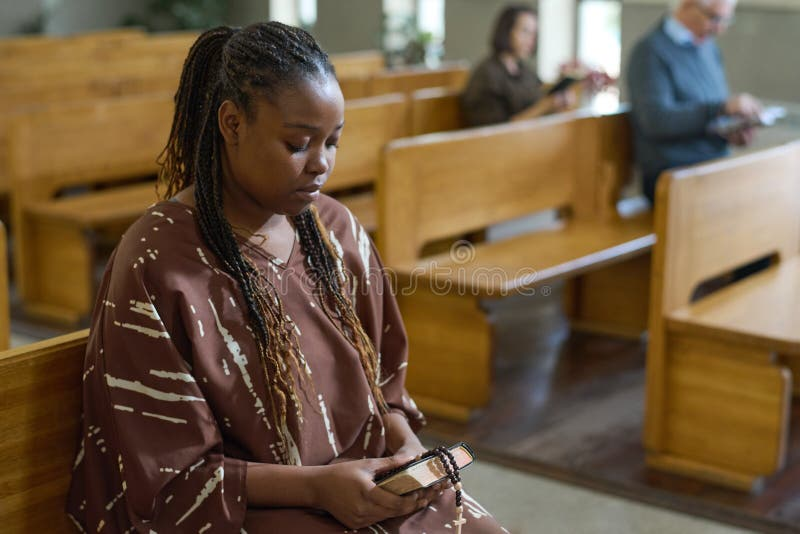
I may sit there on Sunday and hear a hymn that suddenly reminds me of her. I may try to sing and discover that my voice has disappeared somewhere between the first line and the second. I may pray and cry at the same time. And I think that will have to be enough.
Because I am beginning to understand that worship does not always come from a heart that has everything figured out.

Sometimes it comes from a heart that is simply willing to remain in God’s presence while saying, “I do not understand this.”
There is a quiet courage in that kind of prayer. It is not the courage people praise because you look strong.
It is the kind that gets dressed, leaves the house and walks into church while carrying a sorrow nobody can see from across the room.
Five days ago, my sister died, and I am still crying. I am still struggling to believe it, and I still do not know what Sunday will feel like. But Sunday will come, and finally it is here. I will go to church with the heart I have rather than the heart I wish I had.
If I am able to sing, I will sing. If the tears come, I will let them come. If all I can manage is to sit quietly and listen, then I will sit quietly and listen.
I am not going to church because I have found an answer to why my sister died. I am going because, for now, faith is the only place I know to take a question this heavy.
Personal Thoughts:
I do not have a beautiful conclusion to my sister’s death, and I am not ready to turn it into one. I only know that she was here, and now she is not. I know that I love her. I know that I miss her.
I know that I am still trying to understand how a person can occupy your world one day and become a memory the next.
So I am giving myself permission to grieve without pretending that I have already arrived at acceptance.
Grief does not mean that faith has disappeared. Sometimes it is that faith is learning how to breathe in a room filled with questions.
One Thing Worth Remembering:
You can love God and still cry over someone you wish He had allowed you to keep.
Let’s Talk:
Have you ever gone to church while carrying a loss that was still too fresh for words? What did worship feel like for you then?
Editor’s Note:
For those walking into church with fresh grief this Sunday, may there be room for the tears, the silence and the questions that have not yet found their answers.























Leave a comment