


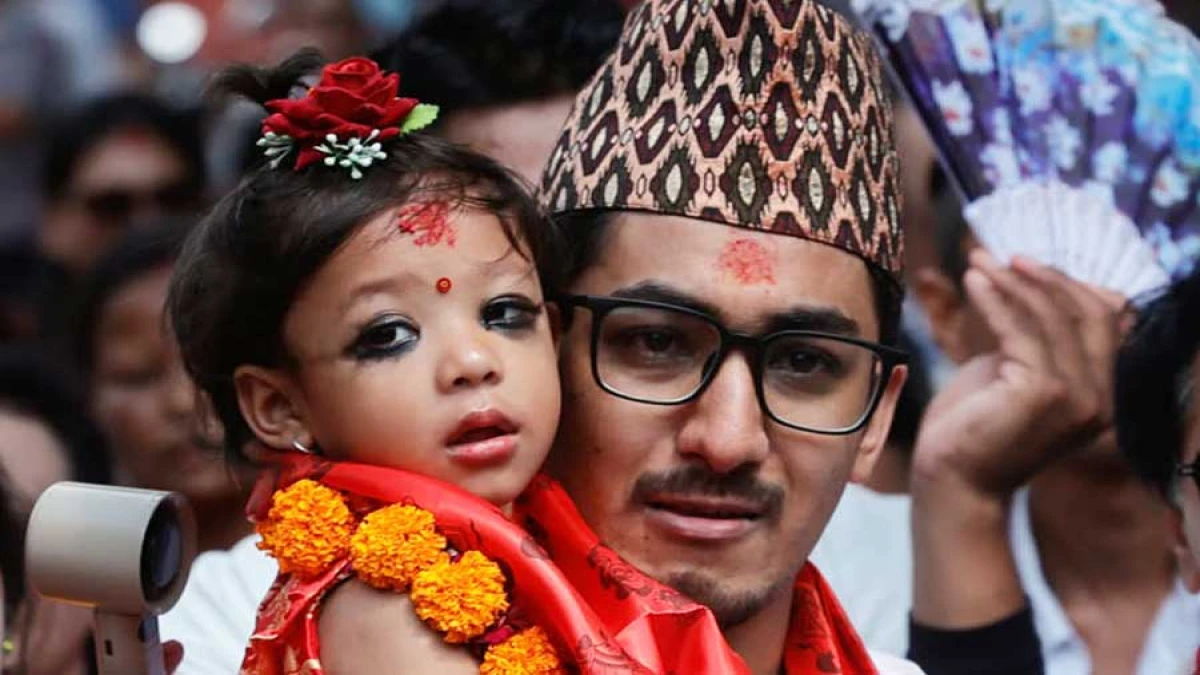
Two-Year-Old Living Goddess Makes First Journey Through Nepal’s Capital
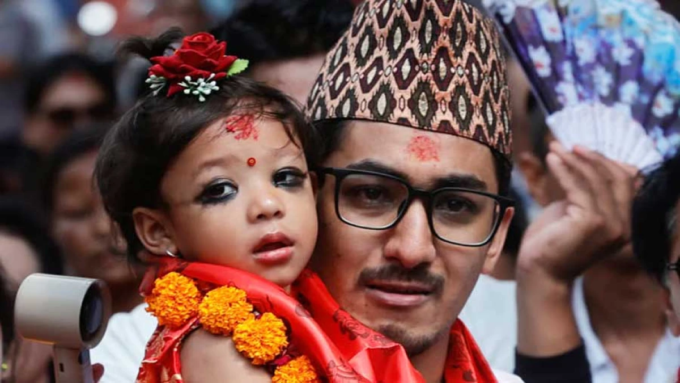
Nepal’s newly appointed Royal Kumari, Aryatara Shakya, has made her first public journey through Kathmandu since taking up the revered role, appearing before thousands of people during the annual Indra Jatra festival.
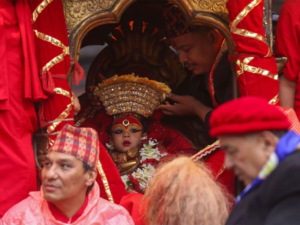
The two-year-old was carried through the historic parts of the Nepalese capital as worshippers and visitors gathered at Kathmandu Durbar Square to catch a glimpse of the young girl regarded as the living embodiment of Goddess Taleju.
Despite persistent rain, large crowds turned out for the traditional procession, which forms one of the major highlights of Indra Jatra.
Shakya was accompanied by two other living deities, Ganesh and Bhairab. The three were carried on separate chariots through Kathmandu as part of the week-long celebration.
For devotees, the appearance of the newly appointed Kumari gave this year’s festival an added significance, as it marked her first Indra Jatra since assuming the position.
One festival attendee, Loyal Chale, described the occasion as memorable, saying he had waited for about three hours to see the new Kumari.
The Kumari tradition is deeply rooted in the Newar community, regarded as the original inhabitants of the Kathmandu Valley. It brings together elements of Hindu and Buddhist traditions that have shaped Nepal’s religious and cultural history.
A girl selected to become Kumari must pass a rigorous traditional selection process. Candidates are expected to be healthy, have no scars or significant marks on their bodies, possess an intact set of teeth and have not yet begun menstruation.
Those who pass the initial requirements undergo further assessment based on 32 traditional physical characteristics considered signs of perfection.
The requirements include features described in traditional terms as a body resembling a banyan tree, eyelashes like those of a cow, a neck like a conch shell and the chest of a lion.
Candidates are also traditionally expected to have straight black hair, dark eyes, soft hands and feet, deer-like thighs and a clear, gentle voice.
Other traditional requirements include serenity, fearlessness and a horoscope believed to correspond with that of the king.
The selection process also includes a ritual test intended to demonstrate courage. Candidates are exposed to a frightening ceremony involving sacrificed buffaloes and masked dancers. Traditionally, any visible display of fear can result in disqualification.
After selection, the Kumari leaves her family home and takes up residence at Kumari Ghar, a historic palace in Kathmandu.
Her contact with her parents is limited, with family visits generally taking place when she appears at designated ceremonial events. She leaves her residence only on specific occasions throughout the year, with Indra Jatra among the most important.
The festival itself is connected to a traditional story about Jayanta, the son of Indra, the Hindu god associated with rain.
According to the legend, Indra came to earth to obtain white flowers for his mother but was captured and tied up by people in the Kathmandu Valley. The celebrations surrounding the story have continued for generations.
Indra Jatra is primarily celebrated by Newar communities practising Hinduism and Buddhism. Similar festivities are also held in Nepal’s Kavre and Dolakha districts.
Senior Nepalese officials attended this year’s procession, including President Ram Chandra Paudel, Vice President Ram Sahaya Prasad Yadav, acting Prime Minister and Finance Minister Swarnim Wagle, Home Minister Sudhan Gurung and acting Kathmandu Mayor Sunita Dangol.
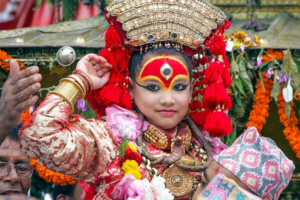
For Aryatara Shakya, the procession marked her first major public appearance as Nepal’s new Kumari and introduced a new generation to one of the country’s most enduring religious traditions.





















Leave a comment