



By: Chioma Madonna Ndukwu
The Way We Live: Daniel Thought He Was Saving Time
Every weekday at 7:18 a.m., the same people boarded the train. The woman with silver-framed glasses always carried two novels in her handbag. The young mechanic leaned against the same door, still smelling faintly of engine oil.

An elderly man folded his newspaper into perfect quarters before reading the first page. A little girl counted stations under her breath while her mother reminded her not to miss school again.
And every morning, Daniel sat in the third carriage with his eyes fixed on his phone. He answered emails before work. He replied to messages during the journey. He watched short videos between stations.
The train could have travelled through mountains or beside the sea. Daniel would not have noticed. One Tuesday morning, the train stopped between stations.
Five minutes passed. Then ten. Passengers looked around.
A little boy, no older than six, tugged at his grandmother’s sleeve.
“Grandma, why has the train stopped?”
“I don’t know.”
“Can I look outside?”
She smiled.
“Go ahead.”
The boy pressed his face against the window.
“There’s a river!” he shouted.
People nearby lifted their heads.
“There are ducks!”
Someone laughed.
“There really are.”
“The water is sparkling.”
The elderly man folded his newspaper.
“I’ve taken this train for twelve years,” he said. “I never knew there was a river here.”
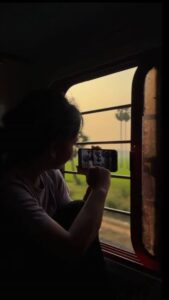
Daniel looked up for what felt like the first time in months. The train was standing beside a quiet stretch of water. Morning light rested gently on its surface. Two fishermen were pushing a small boat away from the bank while white birds skimmed across the river.
It was beautiful. Strangely beautiful. When the train finally moved again, passengers returned to their routines. Everyone except Daniel.
The next morning he left his earphones in his pocket.
The woman with the novels noticed.
“No music today?”
“I think I’ve been missing too much.”
She laughed.
“I stopped wearing earphones years ago. You hear better stories without them.”
He smiled politely. He wasn’t sure what she meant. A few days later, he found out.
An elderly passenger struggled to lift a shopping bag onto the luggage rack.
Before anyone spoke, the mechanic stood up.
“I’ve got it.”
“Thank you,” the old man said.
“No trouble.”
The woman with the novels offered her seat to a pregnant passenger. The little girl proudly announced she had scored full marks in mathematics, and half the carriage applauded.
Someone shared homemade biscuits. Someone else congratulated a stranger who had just received a job offer over the phone.
Daniel realised these things had probably been happening for years.
He had simply been somewhere else. One evening, he arrived home unusually early.
His daughter looked up from the sitting room floor.
“Daddy… are you working tonight?”
“No.”
“Really?”
“No.”
She narrowed her eyes.
“You said that yesterday.”
Daniel felt the words settle heavily between them.
He put his phone on the bookshelf.
“Not today.”
“What changed?”
He thought about the train.
About the river.
About the little boy who had looked out of the window instead of down at a screen.
“I remembered how to look up.”
That weekend, Daniel left his phone inside the house while he and his daughter walked through the neighbourhood park.
She pointed at butterflies. He pointed at clouds that looked like ships. Neither of them checked the time.
Months later, Daniel was travelling for work when he noticed something that would once have escaped him.
In a café in Seoul, two friends sat together, each staring at separate screens while silence filled the table between them.
At an airport in Toronto, a father answered emails while his son pressed his face against the window, watching aircraft take off alone.
In Buenos Aires, a waiter called a customer’s name three times before she realised her coffee had gone cold beside the phone she never put down.
The places were different and the habit was familiar. Daniel wondered how many sunsets had gone unseen, how many conversations had ended before they began, and how many ordinary moments had quietly slipped away while people were looking somewhere else.
That evening, he reached home before dinner. His daughter ran to the door.
Without saying a word, she took his phone, placed it on the bookshelf and smiled.
“You won’t need this.”
Daniel laughed.
“No,” he said. “I don’t think I will.”
Years from now, he would forget most of the emails he answered on trains.
He would never forget the morning a delayed train introduced him to a river that had always been there.
The Truth:
Attention is one of the greatest gifts we can give another person. We often think we are losing time when we look up from our screens. More often, we are finding the moments that make time worth remembering.
One Thing Worth Remembering:
Around the world, people speak different languages, eat different foods and live different lives. Yet everywhere, someone is hoping the person they love will look up, listen and truly be present. The smallest moments are often the ones that quietly become our biggest memories.
What about you?
When was the last time you looked up and discovered something that had been there all along?






















https://shorturl.fm/ITPgl