


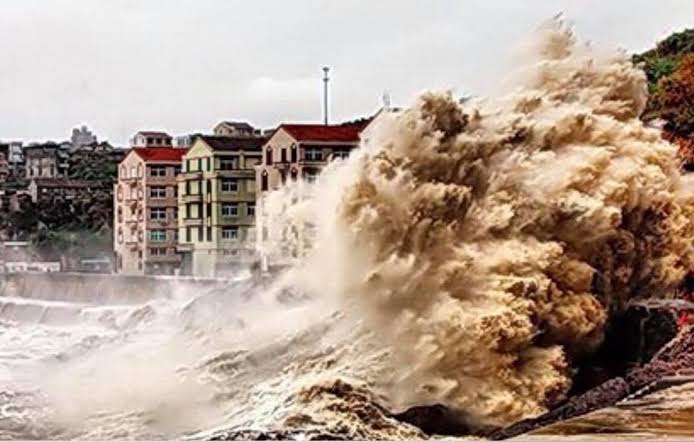
Nearly 2 Million Evacuated as Typhoon Bavi Slams Eastern China
Nearly two million people were forced to leave their homes after Typhoon Bavi crashed into China’s eastern coastline late Saturday, bringing destructive winds, torrential rain and widespread disruptions across parts of East Asia.
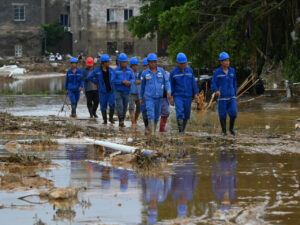
The storm came ashore in Taizhou, Zhejiang Province, with maximum sustained winds of about 144 km/h (90 mph), according to China’s National Meteorological Center.
Although forecasters said Bavi is gradually weakening as it moves inland, officials warned that the huge volume of moisture carried by the storm could still trigger severe flooding and landslides.
Authorities launched one of the region’s largest evacuation operations, relocating more than 1.7 million residents in Zhejiang Province.
Tens of thousands more were evacuated from neighbouring Fujian Province, Shanghai and Beijing as emergency agencies prepared for heavy rainfall and dangerous weather conditions.
Residents in vulnerable communities rushed to secure their homes and gather essential supplies before the typhoon arrived.
Many expressed confidence in the government’s preparedness, saying previous experience with powerful storms had helped communities respond calmly.
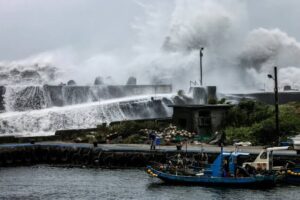
Before reaching mainland China, Bavi swept across Japan’s southern Sakishima Islands and passed north of Taiwan, leaving a trail of disruption.
While neither Japan nor Taiwan reported any fatalities linked directly to the storm, authorities in Taiwan said more than 100 people sustained mostly minor injuries.
Taiwan activated emergency measures ahead of the typhoon’s approach, evacuating more than 14,000 people from high-risk areas.
Nearly 1,200 flights, including international and domestic services, were cancelled, while schools, government offices and many businesses suspended operations.
Rail services continued on a limited schedule, although strong winds and heavy rain affected travel in several parts of the island.
In some mountainous districts around Taipei, powerful wind gusts uprooted trees and caused rivers to swell.
Elsewhere in the region, the Philippines reported 17 deaths after heavy monsoon rains intensified by Bavi caused widespread flooding, underscoring the broader impact of the weather system beyond the areas where it made landfall.

Meteorological officials continue to monitor the storm’s movement, warning that although wind speeds are expected to weaken, persistent rainfall could still pose a serious threat in the coming days.
























https://shorturl.fm/SMkhV