


By: Chioma Madonna Ndukwu
The Way We Live: Does God Really Need Our Offerings?
Now that you are back from church, your shoes are probably somewhere near the door, your Bible is resting on the table and the Sunday clothes have finally been exchanged for something more comfortable.
Maybe you have eaten. Maybe you are still deciding what to do with the rest of the day.
But before Sunday disappears into Monday, let me ask you something.
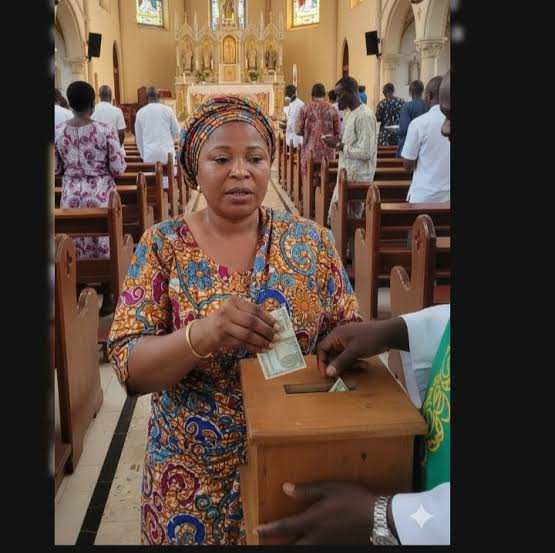
If the offering basket came around and you had only enough money left for your transport home, would you give it away if the minister told you that God would move on your behalf?
I have been in churches where people were encouraged to give even their last money, including the money meant for their journey home.
The message was simple; give it to God and see if He would not move to help you. It sounds like faith when you hear it from a pulpit.
But what happens when the person sitting in the pew is already struggling?

I know of a young woman who had just completed NYSC and was still searching for a job. She had been saving what little she had, hoping it would carry her through the uncertainty of unemployment.
Then a pastor told her that he saw death hanging around her life and that God was interested in blessing her. She gave a substantial amount.
Another young woman, also a former corps member looking for work, was asked to provide ₦200,000 so a pastor could buy pulpits and place them in three churches.
She was told that the altars would speak for her and silence the wicked voices speaking against her destiny.
These stories raise a difficult question. At what point does an act of giving stop being an expression of faith and begin to feel like pressure?
Christianity has never presented God as someone whose needs are waiting to be met by human money. Psalm 50 puts the matter rather boldly: “If I were hungry, I would not tell thee: for the world is mine, and the fulness thereof.”
That is a powerful reminder. God is not a poor man standing at the door of humanity, waiting for someone to make Him rich.
Giving has a place in Christian worship. It supports churches, helps the needy, sustains ministries and allows people to participate materially in the work they believe in.
Scripture also teaches generosity. The New Testament says that each person should give what they have decided in their heart, “not grudgingly, or of necessity: for God loveth a cheerful giver.” That last part matters.
Giving should come from conviction, gratitude and willingness. It should not require a person to panic about what will happen if they refuse.
There is a difference between encouraging generosity and creating fear around money.
A person can give because they are grateful. They can give because they want to support their church. They can give because they have been blessed and want someone else to experience relief.
But if someone is told that refusing to give will keep a spiritual enemy alive, delay a blessing or allow death to come closer, the decision is no longer being made freely. Fear has entered the offering basket.
And fear can be a very expensive thing when it is placed beside spiritual authority.
This is where discernment becomes important. The Bible itself tells believers in 1 John 4:1, “Beloved, believe not every spirit, but try the spirits whether they are of God.”
That instruction does not tell Christians to reject every spiritual message. It tells them to examine what they hear.
That examination is especially important when money enters the conversation.
Faith should not make people incapable of asking questions. If anything, mature faith should give people enough confidence to ask whether a request is reasonable, whether it agrees with Scripture and whether the person making the request is helping them or frightening them into compliance.
There is also something uncomfortable about asking a young unemployed person to surrender the little money she has because a prophecy has frightened her.
What happens if she has no money for transport the next morning?
What happens if she needs food?
What happens if she needs to print another CV, attend an interview or pay for a professional examination?
Does keeping those basic needs covered mean she lacks faith?
James offers another perspective when he writes, “Even so faith, if it hath not works, is dead, being alone.”
Faith is not presented there as an excuse to abandon wisdom. Prayer and practical responsibility can live in the same house.
A Christian can pray for employment and still send out applications.
A person can believe God for healing and still visit a hospital.
Someone can trust God for provision and still budget carefully.
And someone can give generously without giving away the money needed to survive simply because they are afraid that God will punish them for keeping it. This conversation is not uniquely Nigerian.
In the United States, prosperity-gospel preaching has long attracted criticism for connecting financial giving with divine blessing.
In Ghana and South Africa, prophetic ministries have also faced public debates over the use of spiritual authority, prophecy and financial expectations.
The details may differ from one country to another, but the human vulnerability is familiar. People who are frightened, unemployed, sick, grieving or desperate for a breakthrough are often willing to hold tightly to any promise that sounds like an answer.
That is why spiritual leaders carry enormous responsibility.
A person standing behind a pulpit is not simply speaking to ears. Sometimes they are speaking to someone who has exhausted every other option.
They may be speaking to a widow, a young graduate waiting for employment, a parent worried about school fees or someone quietly battling an illness. Words from that position can heal. They can also wound.
The story of the widow who gave two small coins remains one of the most striking examples of giving in the Bible. Jesus noticed her because of what her gift represented, not because she had enough money to impress anyone.
That distinction matters. The value of giving is not always measured by the size of the envelope.
Sometimes the most meaningful gift is the one given freely, within one’s means and without the fear that something terrible will happen if the money stays in one’s pocket.
I do not believe the answer is to stop giving. Churches need generosity. Communities need generosity. Families need generosity. The poor need generosity. There is beauty in giving when it comes from love rather than fear.
But generosity becomes difficult to recognise when people are cornered by frightening predictions, pressured beyond their means or made to feel that God’s attention can be purchased.
There is also a question we do not ask often enough: can someone be generous in church and still overlook the helpless sitting within reach?
A person may be able to give a large offering at church but walk past a hungry neighbour, an unemployed graduate, a struggling widow or a child who needs school support.
Yet Jesus placed enormous value on how we respond to people in need. In Matthew 25:40, He said, “Inasmuch as ye have done it unto one of the least of these my brethren, ye have done it unto me.”
Perhaps Christian giving should make our hands more open to people, not simply to the offering basket. Supporting the church has its place, but so does noticing the person beside us who is quietly struggling to survive.
Maybe the offering basket should remind us of generosity, not terror.
Maybe a pulpit should give people courage, not make poverty feel like a spiritual failure.
Maybe faith should help us lift our eyes when life becomes difficult, while wisdom reminds us to keep enough money for the journey home.
And maybe, just maybe, the question is not whether God needs our offerings.
The better question is what kind of heart are we bringing when we give them?

Personal Thoughts:
I have watched people give when they were afraid not to give, and I have also watched people give because they genuinely wanted to help.
The two things may look identical from the outside. Money leaves the hand and enters the basket.
But the heart behind the giving can be completely different. That is why this conversation matters.
Nobody should be mocked for giving to God. Nobody should be made to feel foolish for supporting a church they love.
But nobody should also be made to believe that poverty, misfortune or death will automatically follow because they could not afford a particular offering.
There should be room for faith and wisdom.
God does not become more powerful because we gave more money. And our inability to give a large offering does not make us less worthy of His care.
One Thing Worth Remembering:
Give when your heart is willing. Give according to what you can afford. Give because you believe in the good your giving can accomplish.
But never let fear become the reason you empty your hands.
Let’s Talk:
Have you ever been encouraged to give money in church because you were told something bad would happen if you did not?
Where do you think the line lies between encouraging generosity and applying spiritual pressure?

























Leave a comment