


Spain Hit by Massive Migrant Surge as 60,000 Enter Ceuta From Morocco, 34 Dead
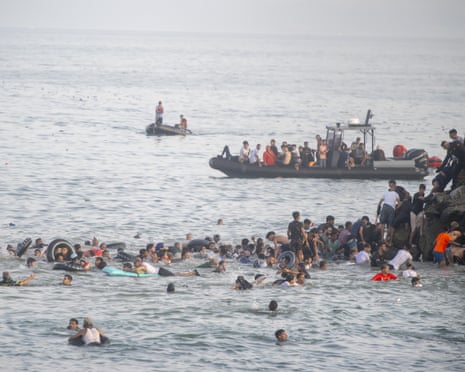
Spain is facing a major migration crisis after about 60,000 migrants crossed from Morocco into the Spanish enclave of Ceuta within 24 hours, according to Ceuta’s regional president.
At least 34 people have reportedly died during the crossings, with many drowning while attempting to reach Spanish territory by sea. Others were caught in the chaos and crush of people trying to pass through the border area.
“The situation that Ceuta is going through is absolutely unsustainable,” Ceuta President Juan Jesús Vivas said on Friday.
The crisis erupted on Thursday and continued into Friday as Moroccan security forces tried to prevent further crossings while large numbers of migrants gathered near the border.
Spanish Prime Minister Pedro Sánchez, who travelled to Ceuta on Friday, condemned the mass entry, describing it as a violation of Spain’s territorial integrity.
Sánchez blamed human-smuggling networks for encouraging vulnerable migrants to make dangerous journeys, saying many young people had been deceived and ultimately exposed to deadly risks.
Images from the border showed hundreds of migrants gathered on a hillside overlooking Ceuta as Moroccan forces used tear gas to disperse them.
At the same time, others continued swimming towards Spanish territory, while some migrants who had already entered began making their way back into Morocco.
Rachid Sbihi, who heads a workers’ association representing Spanish Civil Guard officers, described the situation as a serious humanitarian crisis.
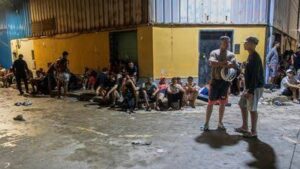
He said thousands of migrants, including unaccompanied children, had been left sleeping in parks and on pavements because reception facilities were overwhelmed.
“People are still entering,” Sbihi said. “The reinforcements, including Spanish military troops, that have arrived are only helping the injured and other humanitarian efforts. It’s chaotic.”
Among those who died were migrants who drowned in the waters near the border, while others were reportedly killed during a stampede close to the breakwater fence at Tarajal beach.
Ahmed Karim, a 33-year-old Moroccan who made the crossing, said the lack of employment opportunities was one of the reasons he decided to leave.
“Many people want to go to Europe, America, but they don’t have the opportunity,” he said.
By Friday morning, shoes, buoys and other belongings abandoned by migrants could be seen in the waters near the border fence.
Moroccan authorities increased their presence along the crossing points, deploying additional personnel, water cannons and warning shots to discourage migrants from entering Ceuta. Rights groups, however, said people continued to make the journey through the water.
Achraf Maimouni, a human rights activist in Fnideq, the Moroccan city bordering Ceuta, said the land border remained closed but migrants were still finding ways to cross through the sea.
Those detained by Moroccan authorities were taken away from the immediate border area, yet attempts to reach the Spanish territory continued.
Morocco’s ambassador to Spain, Karima Benyaich, expressed hope that those who crossed would return, describing the situation as difficult and stressing Morocco’s support for legal and orderly migration.
Spanish authorities have associated the sudden surge with a recent Supreme Court ruling concerning migrants who enter Spain by sea.
The decision stated that such migrants could not simply be returned in the same manner as those who cross by land or scale the border fence.
Sánchez said the ruling may have been misunderstood and amplified by smuggling networks, which he suggested used social media and other channels to encourage the sudden movement.
Ceuta, a Spanish autonomous city on the northern coast of Africa, is separated from Morocco by a heavily guarded border.
Migrants often attempt to reach it by swimming from Fnideq, a journey of several kilometres through open water.
The migration crisis has also reignited political tensions in Spain. Sánchez’s government has faced criticism over its more liberal migration policies, including a plan earlier this year to grant residency and work permits to hundreds of thousands of migrants already living in Spain without legal status.
Opposition figures have argued that such policies could encourage further migration, with some using the events in Ceuta to attack the government.
The crisis has also drawn reactions from other European countries. Italian Prime Minister Giorgia Meloni warned that Italy could reconsider its arrangements with Spain over border controls, while France announced tighter checks along its border with Spain.
Madrid rejected suggestions that its migrant regularisation programme was responsible for the crisis, insisting that the current surge was linked to the interpretation of the court ruling and its alleged exploitation by smugglers.
Meanwhile, migrants also attempted to cross into Melilla, Spain’s other autonomous city on the North African coast.
Clashes were reported in the Moroccan town of Bni Nsar, where migrants allegedly threw stones and set police vehicles on fire.
Ceuta’s authorities had already warned that migrant reception facilities were under severe pressure before Thursday’s mass arrival.
Spanish authorities have not yet released a final official figure for the number of people who crossed into Ceuta, although estimates from Spanish media and security sources have placed the number in the tens of thousands.
The unprecedented movement has left Spain confronting one of its most serious migration and border emergencies in recent years.