



Kenyan Court Hands Religious Leader 200-Year Sentence Over Children’s Deaths
A Kenyan court has sentenced religious leader Paul Mackenzie to 200 years in prison over the deaths of 190 children allegedly starved under his instructions.

Justice Diana Kavedza delivered the sentence on Friday, imposing 100 years for murder through starvation and another 100 years for direct homicide.
Mackenzie led an apocalyptic religious movement along Kenya’s coastal region, where he allegedly persuaded followers to abandon food and water to secure heaven’s promise.
He reportedly convinced members that extreme fasting would enable them to reach heaven before the world’s anticipated end, exposing vulnerable families to deadly conditions.
Court proceedings revealed that threats, physical violence and confinement were used to enforce the instructions, leaving several followers, particularly children, unable to escape.
Some victims were beaten for seeking food or water, while others were locked inside buildings and abandoned. Investigators also discovered bodies in shallow graves.
Authorities recovered remains from latrines and other locations across Shakahola Forest, with some victims reportedly buried alive during the deadly religious exercise.
Twenty-eight other defendants convicted alongside Mackenzie received prison sentences ranging from 10 to 160 years, following their convictions in the same case.
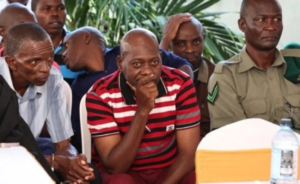
Mackenzie appeared before the court wearing a grey polo shirt and black trousers, maintaining an expressionless appearance as the judge announced his sentence.
He had denied ordering followers to starve themselves or their children, but the court rejected his defence and found him guilty.
His lawyer, Lawrence Obonyo, who represented Mackenzie and several other defendants, said the defence team would challenge the judgment through an appeal.
During sentencing, Justice Kavedza condemned Mackenzie’s exploitation of religious influence, particularly his manipulation of vulnerable followers and exposure of innocent children to deadly conditions.
The judge explained that Mackenzie attracted thousands of subscribers through religious broadcasts on YouTube before using his influence to promote dangerous instructions.
She described how children watched their siblings die after enduring several days without food, highlighting the devastating consequences of the group’s activities.
Kavedza further disclosed that children who attempted to obtain food or water were beaten, restrained and locked inside buildings designated as fasting centres.
The case attracted international attention in April 2023, when Kenyan police began recovering human remains from Shakahola Forest, near the coastal town of Malindi.
Although the trial examined 190 children’s deaths and one adult’s murder, the Kenya National Commission on Human Rights reported 448 recovered bodies.
Mackenzie is also facing a separate trial involving 52 people whose bodies were allegedly discovered at another location approximately 30 kilometres away.
If those additional deaths are established, the suspected number of victims connected to the religious movement could reach 500, although Mackenzie denies the allegations.
The Shakahola tragedy has drawn comparisons with other devastating cult-related deaths, including Uganda’s 2000 massacre, which claimed more than 700 lives.
Another historical comparison is the 1978 Jonestown massacre in Guyana, where more than 900 people died after an American cult leader ordered mass poisoning.
Beyond the courtroom proceedings, the tragedy has left families struggling with grief, unanswered questions and uncertainty about relatives who disappeared into the forest.
Stephen Mwiti, 48, said his wife, convicted as one of Mackenzie’s accomplices, had taken their six children to Shakahola, where they died.
Questioning the decision to expose children to the deadly fasting exercise, Mwiti asked why their lives were sacrificed for an adult’s religious convictions.
“Even if the adults had agreed to fast, what about the children?” he said before the court delivered its judgment.
Meanwhile, Suleiman Zero, whose wife and six children remain missing, broke down in tears outside the courtroom following the sentencing announcement.
Although he welcomed the judgment, Zero appealed to the government to help locate his family or recover their remains if they were dead.
“I am happy but where is my family?” he asked, requesting that authorities return their bodies so he could give them proper burials.
Mackenzie’s son, Dan Mackenzie, also welcomed the judgment, revealing that he abandoned the religious movement during his early teenage years.
He explained that losing faith in the group’s promises of heaven influenced his departure, although the decision cost him friendships and his younger brother.
Describing the judgment as justice for those who died in Shakahola, he expressed satisfaction with the court’s decision.

























Leave a comment