

By: Chioma Madonna Ndukwu
Oma’s Unexpected Encounter With Prisoners on Oshodi Road, Lagos
“Madam, do you want to give them something too?”
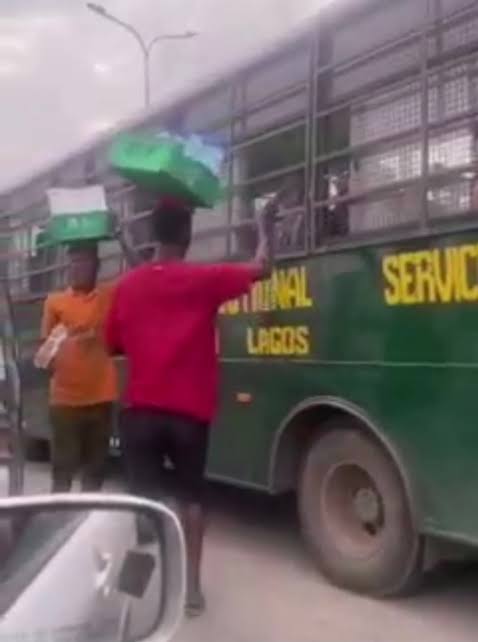
I turned towards the man who had spoken to me. I had been watching the prison van that had stopped a short distance away because of the traffic, and I was still trying to understand what I was seeing.

The small windows of the van had become the centre of attention, with hands appearing through them and reaching towards people outside.
“Give them what?” I asked.
“Anything you have,” he said. “Food, water, anything.”
I looked again. A woman was already standing beside one of the windows, passing something to a prisoner.
Another person had brought water. Someone else was handing over money, while others were giving biscuits, sweets and whatever they happened to have with them.
The men inside were stretching their hands through the little openings, receiving whatever the people outside were willing to give.
I was on my motorcycle, but for a while I almost forgot about the traffic around me. I kept watching because I had never seen anything quite like it.
These were prisoners being transported along Oshodi Road, yet the moment the vehicle stopped, people who did not appear to know them began treating them like people who simply needed something.
“Do they know these people?” I asked the man.
He shrugged. “Maybe some of them do. Maybe some don’t.”
That answer made me look at the van differently. I began wondering about the people behind those windows. Who were they? What had brought them there?
Were they already convicted or were some still waiting for their day in court? Were their families aware of where they were? Did someone at home still worry about them every night?
I had no answers. All I could see were their hands.
One hand would disappear after receiving something, and another would immediately appear. Someone gave food.
Someone gave water. Another person pressed money into an outstretched hand. There was something almost ordinary about it, yet the setting made it unusual.
These were people in custody, separated from the public by metal and glass, yet for those few minutes, strangers were reaching across that boundary to help them. I remember thinking, This is us.
We can condemn what somebody has done and still feel sorry for him when we see him hungry. We can believe that a person should face the consequences of his actions and still find it difficult to ignore him when he stretches out his hand.
Then I noticed something else being passed towards the vehicle. I could not establish exactly what it was, but it looked like a prohibited substance.
I remember thinking that this was where the whole thing became complicated. If someone is hungry, give him food. If he is thirsty, give him water.
But if what we are giving him can put him in further trouble or compromise his custody, then perhaps compassion has crossed into something else.
The man beside me seemed to notice my hesitation.
“You can give them something if you want,” he said.
I smiled. “I am still watching.”
He laughed and moved closer to the van.
I stayed where I was.
For some reason, I could not stop thinking about the fact that I did not know a single thing about those people. I did not know their offences, their families or their stories.
I only knew that they were prisoners because of the vehicle carrying them. Yet when their hands appeared through those windows, the first thing many people saw was not a criminal. They saw someone asking for something.
That thought took me somewhere else. What happens to a person after society gives him a label Do we stop seeing him completely?
Of course, there must be consequences for wrongdoing. Victims deserve justice, and society needs laws. Nobody should confuse kindness with permission to break those laws.
But punishment does not have to mean that we lose every ability to recognise another person’s humanity.
Nelson Mandela spent 27 years in prison, and his life later became one of the world’s most powerful examples of transformation.
He once said, “No one is born hating another person.” I thought about those words as I watched the van.
I wondered how many people inside it had once been children whose families imagined completely different futures for them. I wondered how many had made terrible choices.
I wondered how many regretted those choices. I wondered whether some were still capable of becoming different people. Maybe that is why the people outside the van kept giving.
They were not conducting investigations. They were not deciding who deserved a second chance. They were simply responding to what they saw at that moment.
A man was hungry, so someone gave him food. Someone was thirsty, so another person gave him water. Someone stretched out a hand, and another hand reached back.
The traffic eventually began to move, and the prison van started pulling away. The hands gradually disappeared behind the small windows as the vehicle joined the line of cars and buses moving along Oshodi Road.
I watched it disappear, but the question the stranger had asked me remained in my mind.
“Do you want to give them something too?”
It sounded simple when he asked it, but I realised that it was not really a simple question.
It was asking me what I believed about people who had fallen on the wrong side of the law. It was asking whether compassion should depend entirely on someone’s circumstances.
It was asking whether I could separate the person from the offence long enough to recognise that the person was still human.
And possibly that is something we do not talk about enough. We talk about prisoners as though the word itself tells us everything we need to know about them.
We forget that before a person became a prisoner, he was someone’s child, someone’s brother, someone’s husband, someone’s father or simply somebody who once had a completely different life.
That does not erase whatever he may have done. But it does remind us that people are more complicated than the labels we give them.
As the van disappeared into the traffic, I found myself thinking about the strange kindness I had witnessed on that road.
Lagos had continued around us exactly as Lagos does every day. Drivers were impatient, motorcycles were squeezing through traffic, buses were looking for spaces and everyone seemed to be in a hurry.
Yet in the middle of all that movement, ordinary people had stopped long enough to give something to strangers behind bars. Maybe that is one of the things we should not lose.
We should be able to demand justice without becoming cruel. We should be able to condemn wrongdoing without deciding that the person who committed it is no longer worthy of humane treatment.
And when we choose to help, we should also have enough wisdom to know the difference between compassion and enabling wrongdoing.
I eventually moved on with the traffic, but I kept remembering those small windows and the hands reaching through them.
I never found out who those prisoners were. Maybe I never will.
But for a few minutes on Oshodi Road, they were no longer just names on a charge sheet or faces hidden behind a prison window. They were human beings reaching out, and other human beings decided to reach back.
Personal Thoughts
That encounter reminded me that compassion does not require us to approve of someone’s actions. Sometimes it simply requires us to remember that the person standing before us is still human.
At the same time, kindness must be guided by wisdom, because helping someone should never become another way of helping him break the law.
One Thing Worth Remembering
Perhaps the measure of a society is not only how firmly it punishes wrongdoing, but also how carefully it preserves the humanity of the people it punishes.
Let’s Talk
If you were there with me on Oshodi Road and saw those hands reaching through the prison van windows, would you have stopped to give something, or would you have kept moving because they were prisoners?