

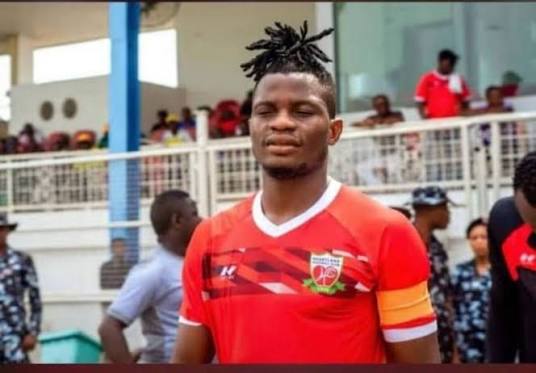
By: Chioma Madonna Ndukwu
From Okwaraji To Ozor: Why Are Ngerian Footballers Still Dying On The Pitch?
For Nigerian football, Chinedu Ozor’s death should have been another painful reminder of an old problem. Instead, it has reopened a wound that has never really healed.
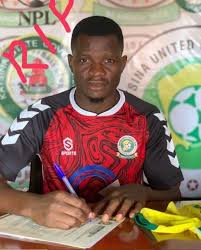
Ozor, a newly signed Katsina United defender, collapsed during his club’s pre-season friendly against Niger Tornadoes in Katsina on August 11, 2026.
The club later confirmed his death, saying he had suffered a medical emergency during the match.
Reports that he regained consciousness after being pronounced dead and taken towards a mortuary created widespread confusion.
Katsina United subsequently rejected the claim, stating that Ozor never regained consciousness and appealing to the public to stop spreading the reports.
The circumstances surrounding Ozor’s death deserve proper medical investigation, and nobody should speculate about the exact cause without the relevant medical findings.
But his death has brought back a question Nigerian football has been forced to confront repeatedly: what happens when a footballer suddenly collapses, and what is available to keep him alive before professional medical help takes over?
The question takes us back to Samuel Sochukwuma Okwaraji, one of the most painful names in Nigerian football history.
On August 12, 1989, exactly 37 years before Ozor’s death, the 25-year-old Nigerian international collapsed during the World Cup qualifier against Angola at the National Stadium in Lagos.
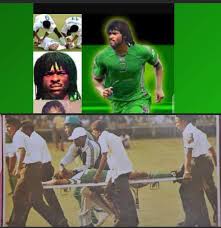
Okwaraji was not simply a promising footballer; he was also a qualified lawyer who had earned a master’s degree in international law.
An autopsy found that he had an enlarged heart and high blood pressure, and his death was attributed to congestive heart failure, with possible hypertrophic cardiomyopathy.
Six years later, Amir Angwe, another Nigerian international, collapsed during Julius Berger’s African Cup Winners’ Cup match against Maxaquene of Mozambique at Onikan Stadium in Lagos.
He was 29. His death was reported as resulting from a heart attack, adding another name to Nigeria’s painful history of footballers who suddenly became victims of medical emergencies during play.
Contemporary accounts of Nigerian football have repeatedly linked Angwe’s death with the earlier tragedy of Okwaraji.
Then came Endurance Idahor. The 25-year-old Nigerian striker collapsed during an Al-Merreikh match in Sudan in March 2010 and died while being taken to hospital.
His death again demonstrated the terrifying speed with which a sporting event can become a medical emergency, where the difference between collapse and survival may depend on what happens before the patient reaches a hospital.
A decade later, Chineme Martins became another name Nigerians would remember for all the wrong reasons. Martins collapsed during an NPFL match between Nasarawa United and Katsina United at the Lafia Township Stadium in March 2020 and later died.
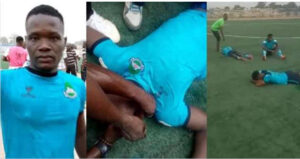
His death did something particularly important to this conversation: it pushed the question of football medical preparedness beyond grief and into accountability.
In 2025, the National Industrial Court was reported to have found Nasarawa United, the league and the Nigeria Football Federation negligent in relation to Martins’ death.
The court’s findings included concerns about incomplete medical examinations and inadequate medical facilities at the stadium. That should have been a watershed moment.
It should have forced every football authority, club administrator and stadium manager to look closely at what happens beside the pitch when a player goes down. Yet the question remains. Then came Michael Eneramo.
The former Nigerian international, aged 40, collapsed during a friendly match in Kaduna in April 2026.
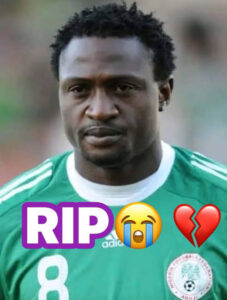
The Nigeria Football Federation said early reports indicated that he appeared to have suffered cardiac arrest about five minutes into the second half. Eneramo was rushed to hospital but died. And now Chinedu Ozor.
The names have changed. The generations have changed. The circumstances surrounding their deaths are not necessarily identical, and it would be irresponsible to suggest that every case had the same medical cause.
But the recurring sight is difficult to ignore: a footballer collapses, the game stops, people rush towards him, and suddenly the emergency response becomes more important than everything that happened before the whistle.
That is where the Nigerian conversation must go. We should not only ask why a footballer’s heart stopped. We should ask what happened after it stopped.
Nigeria’s football authorities are not without rules. The NPFL framework provides for medical personnel, paramedics, emergency arrangements and a defibrillator at league matches.
The regulations recognise that football carries medical risks and that clubs have responsibilities towards players when emergencies occur.
So the issue is not simply that Nigeria has no rules. The more uncomfortable question is whether the rules are consistently translated into functioning emergency care.
A regulation cannot perform CPR. An ambulance parked beside a stadium cannot save a player if it is empty or inadequately equipped.
An AED cannot help anybody if nobody knows where it is, whether it works or how to use it. A medical plan sitting in an office cannot respond to a player lying unconscious on the grass.
This is where the difference between having emergency provisions and being emergency-ready becomes painfully important.
Anybody who has spent time around Nigerian sporting venues knows that an ambulance at a stadium does not automatically mean that a complete emergency response system is available.
There may be a vehicle, but what is inside it? Is there oxygen where it is required? Is the equipment functional? Is there somebody trained to use it? Can the ambulance leave immediately? Is a qualified medical team present? Has the receiving hospital been identified and alerted?
These are not questions to be answered after a player dies. They should be answered before the match begins.
International resuscitation guidance for sports settings places enormous importance on rapid recognition of cardiac arrest, immediate CPR and rapid access to an automated external defibrillator.
The reason is simple: cardiac arrest is a race against time, and professional medical care may not arrive in the first crucial moments.
This is why Nigeria needs to change the way it thinks about CPR.
CPR should not be regarded as something reserved for doctors, nurses and paramedics. It is a lifesaving skill that can be taught to ordinary people, including footballers, coaches, referees, security personnel, teachers, journalists and spectators.
In an Orbit News interview, Mr. Joseph Obiako, a Nigerian based in Canada, recalled losing his mother after she suddenly slumped. “If I had known CPR then, maybe my mother would still be alive,” he said, expressing his regret.
Amina Ahmed of Yobe State also recalled an NYSC colleague collapsing during a parade when “there was no ambulance, no oxygen and no emergency equipment.” She said corps members had to resuscitate her before she could be taken for medical care. Thankfully, she survived.
The person standing beside a collapsed footballer may not be a doctor. He may be a teammate, a coach, a security officer, or even a spectator who happened to be close enough.
And while somebody is calling for an ambulance, somebody trained should know how to respond appropriately if the person is unresponsive and not breathing normally.
That does not mean people should perform medical procedures recklessly or ignore professional help. It means that waiting must not become the emergency plan.
The ambulance should come. The doctor should come. The paramedic should come. The hospital should be ready. But while all of them are coming, the person who is already there should not be completely helpless.
This is especially important because cardiac arrest can happen anywhere, not only on a professional football pitch.
A person can collapse at home, at work, in a church, in a school, in a gym, at a wedding or during a community football match. The emergency does not stop to check whether a medical professional is nearby.
Nigeria therefore needs a broader culture of CPR training and regular practice.
Learning the skill once and putting a certificate inside a drawer is not enough. The American Heart Association notes that CPR skills can begin to deteriorate as early as three months after training.
That should encourage more frequent practical refreshers, particularly for people who work regularly around sports and large gatherings.
A quarterly practical refresher could be considered as a Nigerian public-safety recommendation for high-risk environments, even though formal certification intervals differ across organisations.
The principle is straightforward: learn the skill, practise the skill, refresh the skill and be prepared to use it.
There is another challenge Nigeria must confront, and it is cultural.
When somebody suddenly collapses, we can be very quick to explain the event through spirituality before we establish what is medically happening.
Somebody may say the person has been attacked spiritually. Somebody may begin praying. Somebody may warn others not to touch the victim. Somebody may simply stand there, frightened and confused.
Faith is not the enemy here. Prayer is not the enemy. The danger is allowing spiritual interpretation to delay an emergency response.
One person can pray while another calls for medical assistance. Another can retrieve the AED. Another can clear the crowd. Someone trained can begin appropriate CPR. Someone else can guide the ambulance when it arrives.
There is no conflict between faith and first aid. We must learn that prayer and action can occupy the same moment.
We should also stop treating CPR as an attempt to “take somebody’s destiny” or as an action that automatically means the rescuer caused harm if the victim eventually dies.
CPR is an emergency intervention intended to maintain circulation while professional care is activated.
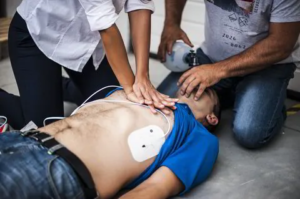
It does not guarantee survival, and not every person who suffers cardiac arrest can be saved. But fear of being blamed must not become an excuse for doing nothing.
This is where government, football authorities and the wider public have responsibilities.
The government should support widespread CPR and basic life-support education, particularly in schools and sports institutions.
Football authorities should enforce the medical standards already contained in their regulations. Clubs should ensure that medical screening is meaningful, that emergency equipment is functional and that their personnel know what to do.
Stadium managers should inspect ambulances and emergency equipment before matches rather than simply assuming that because an ambulance is parked outside, the problem has been solved. And the public must demand accountability.
After Martins’ death, questions about medical preparedness became serious enough to reach the courts. That history should not be forgotten whenever another player collapses.
Because the tragedy is not only that a footballer can die. The tragedy is that a system may sometimes discover what it should have done only after the player is already dead.
The football field should be one of the safest places for an athlete because the risks are known. Physical exertion is part of the game.
Sudden medical emergencies are recognised risks in sport. That knowledge should produce preparation. It should not produce surprise.
We cannot prevent every sudden death. We cannot honestly promise that every collapsed footballer would survive if CPR had begun immediately.
We cannot assign a medical cause to Ozor, Eneramo, Martins, Idahor, Angwe or Okwaraji without respecting the evidence available in each case.
But we can prepare, train, inspect, enforce, and we can put functioning equipment where it is needed.
We can make sure that the person standing closest to a collapsed player is not standing there with nothing but fear in his hands.
Someone collapses, and instead of helping, people gather around with their phones recording the scene.
We have become so eager to capture emergencies that we sometimes forget the person in front of us needs help, not an audience.
When someone falls, put the phone down. Help first. Record later, if there is anything worth recording at all.
From Okwaraji to Angwe, from Idahor to Martins, from Eneramo to Ozor, Nigerian football has accumulated too many painful reminders that a footballer’s physical strength does not make him invincible.
What should distinguish one generation from another is not merely the quality of its players or stadiums, but the quality of its preparedness when something goes terribly wrong.
Chinedu Ozor should therefore not become just another name added to a list of Nigerian footballers who died after collapsing. His death should force a harder question.
If another player falls tomorrow, will the people around him know what to do before the ambulance arrives?
That question reaches beyond football. It reaches the home, the school, the workplace, the church, the community field and every place where a human being can suddenly collapse.
Because the next emergency may not involve a famous footballer. It may involve someone sitting beside us.
And when that happens, the person who saves a life may not be the doctor we are waiting for.
It may simply be the person who was there, who had been trained, who recognised the emergency and who refused to stand still.