


Francis Halzen Wins 2026 Nobel Prize in Physics for Neutrino Research
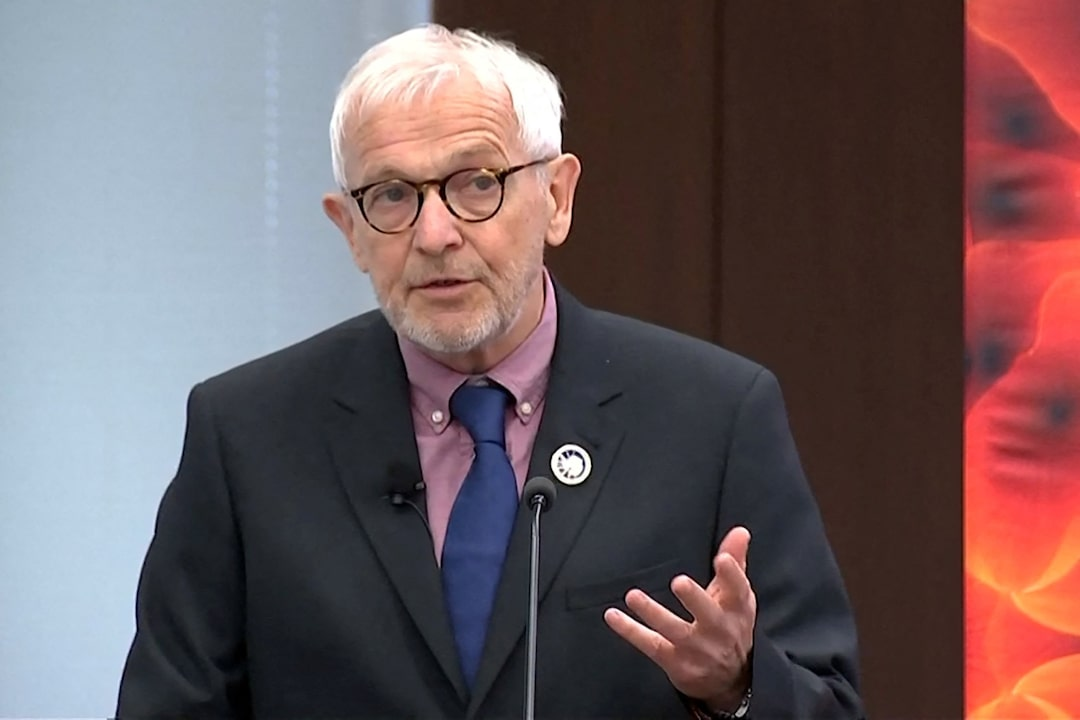
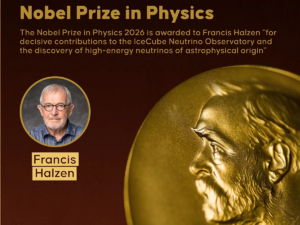
Belgian-American physicist Francis Halzen has won the 2026 Nobel Prize in Physics for pioneering research that turned Antarctic ice into a giant detector for elusive cosmic particles known as neutrinos.
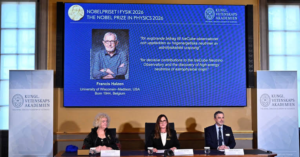
The 82-year-old scientist was honoured for developing the IceCube Neutrino Observatory at the South Pole, a massive scientific facility designed to detect high-energy neutrinos travelling across the universe.
Neutrinos are among the most difficult particles to study because they have almost no mass and rarely interact with matter. They can pass through the Earth with little disturbance, earning them the nickname “ghost particles.”
Halzen recognised that the exceptionally clear ice beneath Antarctica could provide the enormous detection area needed to observe these rare interactions.
The Royal Swedish Academy of Sciences said neutrinos act as messengers from the cosmos, carrying information about distant galaxies and powerful astronomical events that cannot always be observed through conventional telescopes.
The IceCube observatory occupies about one cubic kilometre of Antarctic ice and extends to a depth of roughly 2,500 metres beneath the surface near the South Pole.
More than 5,000 sensors buried throughout the ice detect tiny flashes produced when neutrinos collide with other particles. Scientists use those signals to trace the particles back towards their cosmic sources.
Unlike electrically charged particles, neutrinos are not affected by magnetic fields. Their paths can therefore provide valuable clues about where they originated.
The observations have helped scientists investigate some of the universe’s most violent events, including exploding stars, gamma-ray bursts and extreme activity involving black holes and neutron stars.
Halzen first proposed using Antarctic ice to detect neutrinos in 1988. The ambitious project took more than two decades to complete, with the IceCube observatory becoming operational in 2011.
Reflecting on the project, Halzen said he had been fortunate because many people, including himself, initially questioned whether the experiment would actually succeed.
The observatory has since detected high-energy neutrinos originating both within the Milky Way and from much farther beyond our galaxy, opening a new field of research often described as neutrino astronomy.
Halzen has become one of the best-known figures in the field. In 2014, Smithsonian magazine dubbed him “Neutrino Man” after recognising his work with an Ingenuity Award.
The Nobel recognition comes as researchers prepare to expand the experiment. Plans for IceCube-Gen2 would extend the observatory across about eight cubic kilometres of Antarctic ice.
The next-generation facility is expected to detect up to ten times more neutrinos than the existing observatory, giving researchers a much larger dataset for investigating the origins and behaviour of high-energy particles.
Halzen said the most significant discoveries from his work may still be ahead, arguing that larger and more advanced neutrino telescopes will be needed before the full potential of the new form of astronomy becomes clear.
The 2026 Nobel Prize in Physics comes with an award of 12 million Swedish crowns, worth about $1.2 million.
Halzen now joins an illustrious group of Nobel physics laureates that includes Albert Einstein, Marie Curie, Pierre Curie, Max Planck and Niels Bohr, whose discoveries transformed humanity’s understanding of the physical world.
The Nobel Prize will be formally presented in Stockholm on December 10, the anniversary of Alfred Nobel’s death.
For Halzen, the recognition marks a major milestone in a decades-long effort to use neutrinos as cosmic messengers.
His work has given scientists a new way to investigate distant regions of the universe and study some of its most powerful phenomena.
























Leave a comment