

Elon Musk’s Starlink, Airtel Launch Africa’s First Satellite-to-Phone Service in DRC
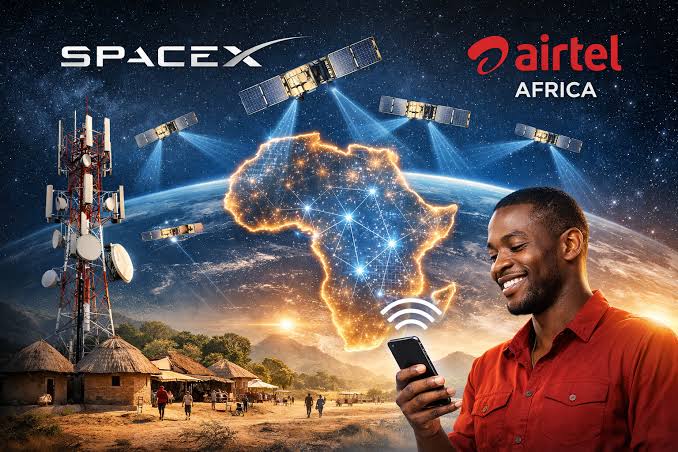
Airtel Africa and Elon Musk’s SpaceX have launched a satellite-to-phone service in the Democratic Republic of Congo (DRC), marking the first commercial rollout of the technology in Africa.

The service, called Starlink Mobile, became commercially available in the DRC on August 14, 2026, allowing eligible Airtel customers to connect compatible smartphones directly to Starlink satellites in areas where Airtel’s regular network is unavailable.
Unlike conventional Starlink internet, users do not need a satellite dish or any special ground equipment. Their smartphones connect directly to satellites, which effectively act as mobile towers in space.
The initial service is limited to SMS and selected low-data applications, including WhatsApp messaging. It does not yet offer unrestricted high-speed internet, video streaming or the full range of services available on conventional mobile networks.
Airtel Africa Chief Executive Officer, Sunil Taldar, described the launch as a major step in extending connectivity beyond the reach of traditional telecommunications infrastructure.
He said Airtel would use the experience gained in the DRC to guide the expansion of the service into its other African markets, subject to regulatory approval.
How Airtel customers can use it
The service is initially available to customers with compatible LTE Android smartphones, while support for Apple devices is expected to come later.
Eligible Airtel DRC subscribers must have an active data bundle or enable data roaming on their devices. They can register through the MyAirtel application and receive free access for an introductory 30-day period.
Airtel has not yet revealed the cost of the service after the trial period or whether it will introduce dedicated Starlink packages.
The technology is expected to be particularly useful in remote communities where conventional mobile towers are difficult or expensive to build.
Mining companies, farmers, transport and logistics operators, health workers and humanitarian organisations could also benefit, particularly in areas with little or no terrestrial network coverage.
The satellite connection could further provide basic communication during natural disasters, conflicts and temporary disruptions to existing telecommunications networks.
Starlink’s journey in the DRC
The launch represents a significant change in the DRC’s relationship with Starlink.
Congolese authorities had previously prohibited Starlink terminals in the country over security concerns, including fears that armed groups could exploit the technology.
That position changed in May 2025 when the Congolese Post and Telecommunications Regulatory Authority granted Starlink DRC SA a licence to operate as an internet service provider.
Starlink’s conventional satellite broadband service later became available in the country, but customers using it require dedicated equipment.
The new Airtel partnership is different because it allows ordinary compatible mobile phones to communicate directly with satellites.
Airtel plans wider African rollout
Airtel Africa and SpaceX announced their Direct-to-Cell partnership in December 2025, with plans to introduce the technology across Airtel’s 14 African markets.
These include Nigeria, Kenya, Uganda, Tanzania, Zambia, Malawi, Rwanda, Niger, Chad, Gabon, Seychelles, Madagascar, the Republic of Congo and the DRC.
The companies successfully tested Starlink Mobile in Kenya in March 2026 in locations where Airtel’s terrestrial network was unavailable.
The DRC has now become the first market where the technology has moved from testing to commercial service.
Airtel said about 650 Starlink satellites are equipped to support direct connections with mobile phones, while newer generations of satellites are expected to deliver faster data services in the future.
However, the expansion will depend on regulatory and spectrum approvals in each country.
The partnership puts Airtel in a growing race with other African telecom operators exploring satellite technology to extend mobile coverage to underserved areas.
For now, the DRC represents Elon Musk’s Starlink’s first commercial direct-to-phone deployment on the continent, a move that could reshape how millions of Africans connect in areas beyond the reach of traditional mobile networks.