


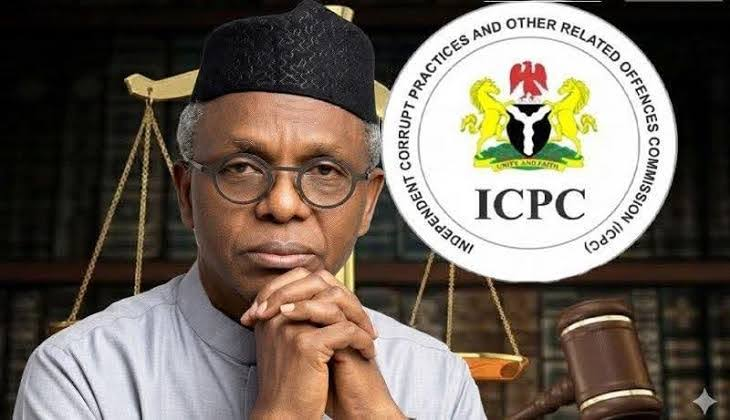
Court Dismisses El-Rufai’s Suit to Block DSS, EFCC From Seizing Assets
A Federal High Court in Abuja has dismissed former Kaduna State Governor Nasir El-Rufai’s suit seeking to stop security agencies from freezing his bank accounts and seizing properties.

Justice Joyce Abdulmalik dismissed the suit on Thursday, ruling that it constituted an abuse of court process because El-Rufai had filed a similar case before another court.
The judge upheld arguments by the Independent Corrupt Practices and Other Related Offences Commission (ICPC), Economic and Financial Crimes Commission (EFCC), Department of State Services (DSS) and Attorney-General of the Federation.
The respondents maintained that courts should not be used to prevent law enforcement agencies from performing their statutory duties, particularly while investigations into suspected criminal activities remain ongoing.
El-Rufai filed the suit on February 24, 2026, through his lawyer, Oluwole Iyamu, a Senior Advocate of Nigeria, seeking protection against possible seizure or forfeiture of his assets.
The former governor asked the court to restrain the respondents from freezing his bank accounts, seizing properties or initiating forfeiture proceedings without complying with relevant legal requirements.
He argued that his severance benefits, received after completing his tenure as Kaduna State governor between 2015 and 2023, were lawfully earned and not proceeds of unlawful activities.
El-Rufai also sought a declaration that properties acquired with the benefits belonged to him legally and should not be subjected to forfeiture without credible evidence supporting suspicion of wrongdoing.
He maintained that any attempt to obtain or enforce forfeiture orders without satisfying legal requirements would violate his fundamental rights, including the constitutional presumption of innocence and fair hearing.
To support his arguments, the former governor cited Section 17(1) of the Advance Fee Fraud and Other Related Offences Act, 2006, alongside a 2024 Supreme Court decision.
He also challenged the use of applications made without notifying affected parties, arguing that concealing material facts could breach constitutional safeguards and undermine his right to a fair hearing.
El-Rufai requested N1 billion in damages for alleged threats to his fundamental rights, psychological distress and reputational harm, alongside N100 million to cover legal fees and associated expenses.
However, the ICPC urged the court to dismiss the case, describing it as incompetent and an abuse of judicial process arising from multiple suits over related issues.
The commission said El-Rufai’s complaints stemmed from an ongoing criminal investigation involving his arrest, the search of his residence and anticipated efforts to trace or freeze his assets.
According to the ICPC, the former governor filed three related suits in different courts within 12 days, creating a risk of conflicting judgments and duplicating claims.
The commission identified a Federal High Court case filed on February 20, 2026, challenging the search warrant and enforcement of fundamental rights, alongside another action concerning his remand order.
That second case was filed at the FCT High Court on March 3, 2026, with El-Rufai challenging the remand order and alleging violations of his fundamental rights.
The DSS also asked the court to strike out the suit, arguing that the former governor had failed to establish a reasonable cause of action against the service.
The Attorney-General of the Federation opposed the case, describing El-Rufai’s claims as speculative and maintaining that interim forfeiture orders did not amount to final forfeiture of property.
The government further argued that the ICPC, EFCC and DSS could approach courts of competent jurisdiction for forfeiture orders when necessary during investigations into suspected offences.
Delivering judgment, Justice Abdulmalik agreed that the suit constituted an abuse of court process because El-Rufai had instituted a similar action before the FCT High Court.
The ruling represents a setback for the former governor’s attempt to secure advance judicial protection against possible asset freezes and forfeiture proceedings by the law enforcement agencies.




















Leave a comment