


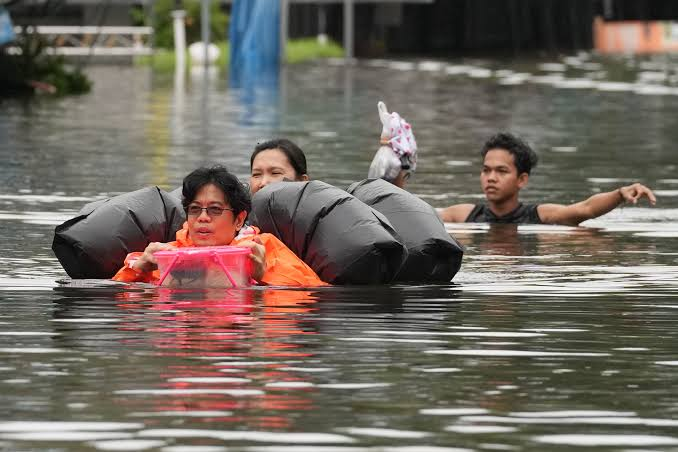
Bangkok Gripped by Flood Crisis as Streets Turn Into Lakes
Bangkok is facing a worsening flood crisis after days of intense rainfall submerged roads, homes and vehicles, disrupted transport and forced thousands of residents into emergency shelters across Thailand’s capital.
Authorities have declared a flood disaster across all 50 districts of Bangkok as rescue teams and drainage workers continue efforts to contain the rising waters.
More than 230 shelters have been opened across the city, while residents in several neighbourhoods have struggled through waist-high floodwater and debris covering streets and residential areas.
Some parts of Bangkok recorded about 300 millimetres of rain within two days, overwhelming drainage systems and transforming normally busy roads into stagnant stretches of water.
The flooding has claimed about 40 lives, according to government figures, with some victims reportedly drowning while others died from accidental electrocution.
Residents said the rainfall was unusually persistent, lasting through the day and night rather than following the shorter afternoon storms commonly experienced during Bangkok’s rainy season.
Suleemas Kurangkul, a 73-year-old resident of north-east Bangkok, said the water continued rising until the streets around her apartment became waist-deep.
She said a mobile phone warning reached residents after the situation had already become difficult, leaving many people unable to move freely through their neighbourhood.
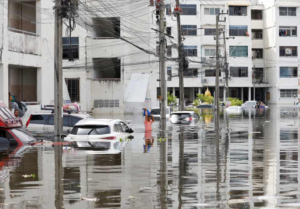
The Khlong Chan housing compound, built in the 1970s, has emerged as one of the most recognisable images of the disaster, with brown floodwater surrounding buildings and almost covering parked vehicles.
Although some of the water had receded by Thursday, residents were still dealing with rubbish, debris and a worsening smell left behind by the stagnant floodwater.
Bangkok’s location on the floodplain of the Chao Phraya River has historically exposed the megacity to flooding, while its drainage system depends on canals, pumps and flood barriers to move excess water.
However, extensive construction and the loss of sections of the city’s traditional canal network have reduced the capacity to drain large volumes of water during periods of extreme rainfall.
The crisis has disrupted almost every aspect of daily life, with schools closing, roads becoming heavily congested and workers unable to reach their workplaces.
Suvarnabhumi airport has also been affected, after a large number of Thai Airways employees were unable to report for duty, contributing to luggage backlogs and flight cancellations.
In some flooded communities, residents have improvised ways to move around, using inflatable pools and other floating objects to reach their homes, while one man was arrested for riding a jet ski along a major road.
Thailand’s Prime Minister, Anutin Charnvirakul, said the Bangkok metropolitan area remained vulnerable to additional flooding as water continued moving south from northern parts of the country.
Authorities have established a special monitoring centre, while weather officials have warned of more heavy rainfall in the coming days.
Scientists say Southeast Asia has experienced increasingly severe episodes of extreme rainfall, although researchers have cautioned that it is too early to directly attribute the latest Bangkok floods to climate change.
Nikolaos Skliris, an ocean scientist at the University of Southampton, said observations showed a small but significant trend towards more extreme rainfall in central Thailand.
He explained that climate models indicate the region could experience further increases in both the amount and intensity of rainfall over the long term.
The immediate flooding was linked to a low-pressure weather system that moved from an unusually warm South China Sea across Cambodia and Vietnam before becoming concentrated over Bangkok.
An unusually strong El Niño pattern has also complicated the weather situation, with recent research indicating that the phenomenon may contribute to episodes of extreme rainfall even though it generally brings drier summer conditions to parts of Southeast Asia.
Naim Laeni, a consultant and university lecturer who co-authored a study on Bangkok’s flood resilience, said authorities had underestimated how long and how heavily the rain would continue.
He said the city’s drainage canals can normally handle significant rainfall, but localised downpours exceeded their capacity and left insufficient time for the system to recover between periods of intense rain.
The same weather system has affected neighbouring Myanmar, where flash floods, blocked roads and landslides have complicated rescue operations.
In southern Myanmar, rescuers have recovered bodies from a landslide that devastated Ka Det Nge Htein village, killing nine people, while others remain missing in another affected community.
The situation in Myanmar has been difficult to assess because of the ongoing civil war and restrictions affecting media access and humanitarian operations.
Back in Bangkok, pumping stations are operating at full capacity as authorities work to drain affected communities, but some areas may require several more days before the floodwaters completely disappear.
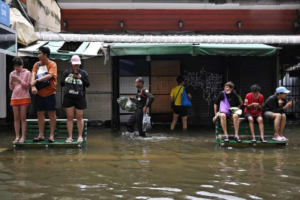
For residents still surrounded by water, the immediate priority remains staying safe and supporting one another while waiting for the city to regain its footing.





















Leave a comment