


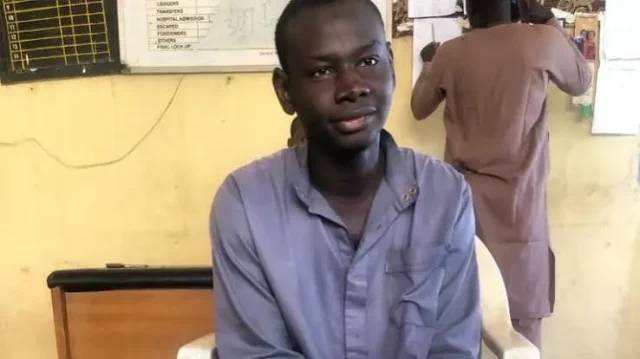
US Demands Freedom For Kano Singer On Death Row Over Blasphemy Song
The United States has demanded the immediate freedom of Kano-based Sufi singer Yahaya Sharif-Aminu, who has been on death row for over five years over a blasphemy song.
The demand was made on Thursday by the US Assistant Secretary of State for Democracy, Human Rights and Labour, Riley Barnes, during a hearing of the US House of Representatives Foreign Affairs Africa Subcommittee.
Barnes said Washington is mounting pressure on the Nigerian government to release the musician and to stop enforcing blasphemy laws across the country.
“We are actively pressing the government of Nigeria and calling for the release of Sufi singer Yahaya Sharif-Aminu, who sits on death row over blasphemy charges, and we continue to urge the government to cease the enforcement of blasphemy laws,” Barnes said.
He also faulted Nigerian state officials for prosecuting citizens over alleged blasphemy, including cases that involve only peaceful speech.
“State officials continue to prosecute individuals for alleged blasphemy or perceived insults to Islam, including peaceful speech, which stands in clear violation of Nigeria’s obligation to safeguard free speech and religious freedom,” he stated.
The hearing, titled ‘One Year Later: Assessing Nigeria’s Efforts to Protect Christians and Secure the Middle Belt’, assessed Nigeria’s handling of insecurity and religious violence.
It came about a year after US President Donald Trump listed Nigeria as a Country of Particular Concern over religious freedom violations.
US Wants Attacks Reduced, IDPs Returned Home
At the hearing, Barnes called for more concrete progress in stopping attacks and ensuring displaced persons return safely to their communities.
He said the US will keep measuring Nigeria’s efforts by the reduction in attacks and the prosecution of perpetrators of violence.
Sharif-Aminu was arrested in March 2020 after he shared lyrics of a song he composed through WhatsApp. The lyrics were considered blasphemous, sparking outrage that led to the burning of his family home by a mob.
A Sharia court in Kano State later convicted him and sentenced him to death by hanging in August 2020.
However, the Kano State High Court quashed the conviction in 2021 on procedural grounds and ordered a retrial. Despite the ruling, he has remained in custody since then.
In November 2022, the singer took his case to the Supreme Court, challenging the constitutionality of Nigeria’s blasphemy laws.
The apex court heard the appeal in September 2025, allowing the legal challenge against the laws to proceed.
Global Bodies Join Call For Release
The case has attracted widespread international condemnation, with the European Parliament passing resolutions demanding his release.
In December 2024, the United Nations Working Group on Arbitrary Detention declared that his continued detention breached several internationally protected human rights and called for his release and compensation.
In April 2025, the ECOWAS Court of Justice also ruled that Nigeria should repeal its blasphemy laws in a matter connected to the musician’s case.
The United Nations Special Rapporteur on freedom of religion or belief, Nazila Ghanea, equally criticised Kano State’s blasphemy law after visiting Nigeria in June 2026.












Leave a comment