


“Get the Best Results at Any Cost”: How AI Is Disrupting South Korea’s Exam Culture
South Korea’s intense reliance on examinations as gateways to education, employment and social status is facing an unprecedented challenge as artificial intelligence raises fresh cheating concerns.
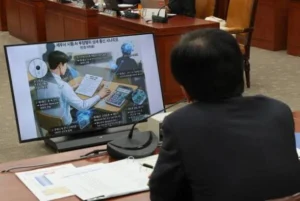
A recent controversy surrounding the national tax accountant examination illustrates the growing suspicion. Several high-scoring candidates faced online allegations that they had used AI-powered smart glasses.
One candidate, 25-year-old Yun Jeong-hu, responded by publishing a 22-minute video explaining his preparation after finishing second in the national examination.
In the recording, Yun displays his heavily annotated tax law textbook, describes lessons and late-night study sessions, and answers a corporate tax question without preparation.
He also explains that he had never worn glasses before attending a job interview, when he worried they might make him appear younger.
Yun said he shared the video to defend the effort behind his achievement, urging social media users to stop circulating unsubstantiated accusations against successful candidates.
Similar displays of proof have emerged elsewhere, with candidates sharing exhausted pen refills, marked textbooks and personal explanations to counter suggestions of technology-assisted cheating.
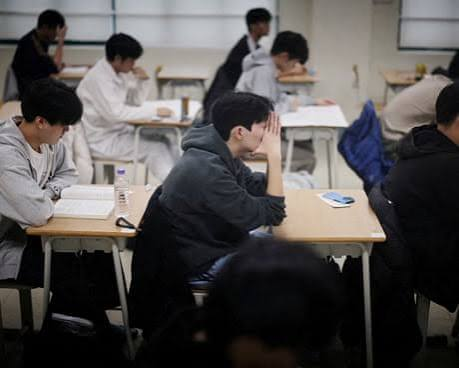
Suspicion has intensified because examinations carry exceptional weight in South Korea, where a single result can influence university admission, career prospects and long-term financial security.
The problem reached a national scale during last week’s eight-hour university entrance examination, known as the Suneung, when authorities issued emergency phone alerts warning candidates against electronic devices.
Education officials said 111 candidates were caught carrying prohibited electronic equipment, while 54 cases were identified after the nationwide alerts were sent.
Some older mobile phones interpreted the alerts as warnings of war, underlining the extraordinary measures authorities adopted to protect the examination’s integrity.
President Lee Jae Myung pledged rewards of at least 100 million won, approximately $74,000, for information leading to the exposure of examination cheating.
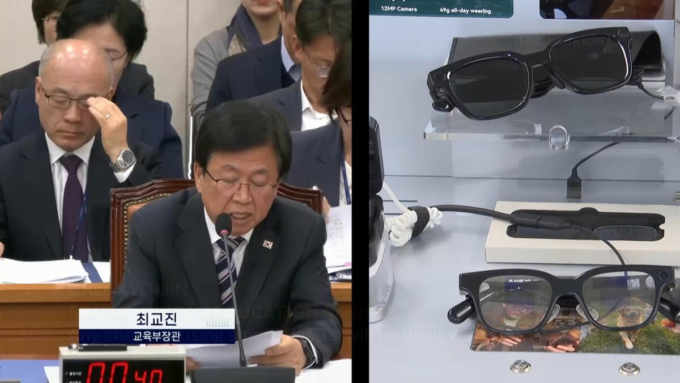
Education Minister Choi Kyo-jin resigned on Sunday following disruption caused by last-minute measures introduced to prevent candidates from using artificial intelligence during the examination.
Sociologist Sangchin Chun of Sogang University says intense competition reflects the belief that examination results determine lifetime income and social standing, encouraging candidates to seek every advantage.
He describes examinations as having become a powerful symbol of fairness, widely regarded as one of the few remaining routes to equal opportunity.
The controversy has also taken a tragic turn. A man who achieved full marks in a recent law school entrance examination faced allegations of using AI.
He had reportedly planned to answer questions from the current Suneung publicly to challenge his critics, but failed to attend the scheduled event last week.
The man was later found dead in a Seoul motel. The allegations that he had cheated had not been established.
South Korea’s examination culture has deeper roots in economic uncertainty following the 1997 Asian financial crisis, according to sociologist Kim Dong-chun.
Kim argues that as secure jobs became harder to obtain, examinations gained acceptance as a seemingly impartial way of distributing increasingly limited opportunities.
Before then, family wealth and personal connections had often influenced access to success, making standardised examinations appear to offer a fairer alternative.
Public confidence in merit-based selection was shaken again in 2019 by a university admissions scandal involving former justice minister Cho Kuk.
Cho was later jailed in connection with the case, which involved falsified academic credentials used to secure places for his children at prestigious institutions.
Following the scandal, the government pushed major universities in Seoul to allocate at least 40 per cent of admissions places according to entrance examination scores.
Sociologist Choi Hang-seop of Kookmin University has described the country as an increasingly unforgiving competition, where falling short can carry serious consequences.
He said many people have come to view success in the Suneung or civil service examinations as essential to securing their future.
The university entrance examination is largely multiple-choice and machine-marked, with no essays, interviews or coursework, reducing opportunities for wealthier families to gain advantages through coaching.
Supporters see the format as an equaliser because candidates sit the same examination simultaneously and their answers are assessed anonymously under standardised conditions.
However, critics argue that the system’s emphasis on memorisation and rapid problem-solving is increasingly outdated, particularly as artificial intelligence can perform many tasks instantly.
In August, national education commission chair Cha Jeong-in argued that multiple-choice testing had reached its limits and that written assessments would eventually become necessary.
The commission failed to reach agreement, delaying the proposal. Although a redesigned Suneung is planned for 2028, its multiple-choice structure is expected to remain.
Chun believes the spread of AI has exposed weaknesses in an assessment model built around recalling information and solving problems under strict examination conditions.
Discussions about possible solutions remain divided between stronger supervision and tougher penalties, or modernising examinations through computer-based testing and revised assessment methods.
Despite the controversy, public faith in examination-based meritocracy remains strong, with many continuing to regard the system as the fairest available route to advancement.
Park Do-soon, who helped design the Suneung and became the first head of the organisation responsible for administering it, has questioned whether such tests remain relevant.

Speaking to Hankook Ilbo, Park said he saw little justification for requiring people to sit examinations when artificial intelligence could produce the answers immediately.





















Leave a comment