

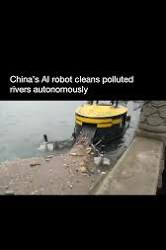
China Turns to Smart River Robots as Battle Against Pollution Intensifies
China is stepping up its war against environmental pollution with the deployment of intelligent river-cleaning robots designed to remove waste from waterways and improve water quality in some of its busiest cities.
In major urban centres such as Beijing and Shanghai, authorities are introducing autonomous vessels that move through rivers, lakes and reservoirs, collecting floating waste while also checking the health of the water in real time.
The robotic machines, powered by artificial intelligence, are built to operate with little or no human control.
Fitted with cameras, satellite navigation systems and environmental sensors, they can detect and gather plastic waste, floating debris, weeds and discarded materials that often clog waterways.
Unlike traditional cleanup efforts that rely heavily on workers and boats, the machines are designed to navigate polluted areas independently.
They analyse water conditions, including acidity levels, visibility, oxygen concentration and other environmental indicators that may signal contamination.
Officials say the technology also helps reduce delays in responding to water pollution because the robots can provide constant monitoring rather than periodic inspections.
One major feature attracting attention is the robots’ ability to return to designated docking points when filled with waste.
After emptying their storage compartments, the vessels automatically head back to continue work, reducing operational downtime and labour costs.
The push comes as China faces increasing pressure to tackle environmental degradation caused by industrial growth, urban expansion and rising waste generation.
Over the years, polluted rivers and poor air quality have triggered public concern, forcing authorities to invest heavily in green technologies and cleaner production systems.
Beyond river cleanup, China has increasingly turned to robotics and industrial automation to cut emissions and improve environmental efficiency.
Studies suggest the wider use of intelligent manufacturing systems has contributed to lower industrial pollution by improving energy use, reducing waste and limiting harmful emissions linked to production.
Experts believe the growing use of AI-driven environmental systems could reshape how cities across the world manage waste and monitor pollution, especially in densely populated areas where traditional cleanup methods often struggle to keep pace.
Environmental agencies in parts of China have reported that automated river-cleaning systems can work faster and more efficiently than manual operations, making them an increasingly attractive tool in the country’s long-term environmental strategy.

















Leave a comment